IEP Transition Service Examples for Training, Work, and Adult Life
Turn post-school goals into individualized instruction, related services, community experiences, and coordinated activities with assigned owners.


Transition services in an IEP should connect a student’s strengths, preferences, interests, and needs to practical activities that support life after high school. A list of generic services—“career exploration,” “self-advocacy,” or “community practice”—is not enough by itself. The team should be able to explain which postsecondary goal each activity supports, who will arrange it, when it will occur, and what evidence will show whether the student had a meaningful chance to participate.
Start with post-school outcomes, then choose the services
IDEA defines transition services as a coordinated set of activities within a results-oriented process that improves academic and functional achievement and facilitates movement to post-school activities. The regulation identifies areas such as postsecondary education, vocational education, integrated employment, adult education, adult services, independent living, and community participation. Services are based on the individual student’s needs and take into account strengths, preferences, and interests.
Separate a postsecondary goal from a transition service and an annual IEP goal. A postsecondary goal describes what the student expects to do after leaving school. A transition service is an activity or support that helps move toward that outcome. An annual goal is a skill the student will learn or demonstrate during the current IEP year. These items should align, but they are not the same sentence repeated three times.
Age and timing requirements can vary under state rules. Federal IDEA requires transition content no later than the first IEP to be in effect when the student turns 16, or younger if the IEP team determines appropriate; states may require earlier planning. Confirm the state’s current age, forms, and invitation/consent procedures. A planning guide focused on age 16 is not permission to delay earlier transition work when state law or student need calls for it.
Use transition assessment to find the right activity
Before choosing services, gather age-appropriate information about the student’s preferences, strengths, interests, and needs. Formal tools may include interest inventories, career assessments, adaptive behavior measures, or self-determination instruments. Informal sources may include interviews, student-led discussions, work samples, direct observation, family perspectives, classroom performance, and community practice. No single test predicts a student’s future. Use more than one source and revisit information as interests and circumstances change.
Ask the student how they want to participate, and provide accessible ways to express preferences. A student might use speech, AAC, pictures, supported decision-making, or a trusted facilitator. Do not treat a communication difference as lack of interest. Invite family perspectives while maintaining the student’s role and following consent and confidentiality rules when coordinating with outside agencies.
Translate assessment into concrete next experiences. If a student is interested in culinary work, a career interest survey alone is not a service. Depending on the student’s needs, an activity might include job exploration with accessible materials, a supervised work-based learning experience, instruction in workplace communication, or travel training to the site. If the student wants postsecondary education, useful activities could include comparing program supports, practicing how to request accommodations, visiting a campus, or learning to manage a course schedule.
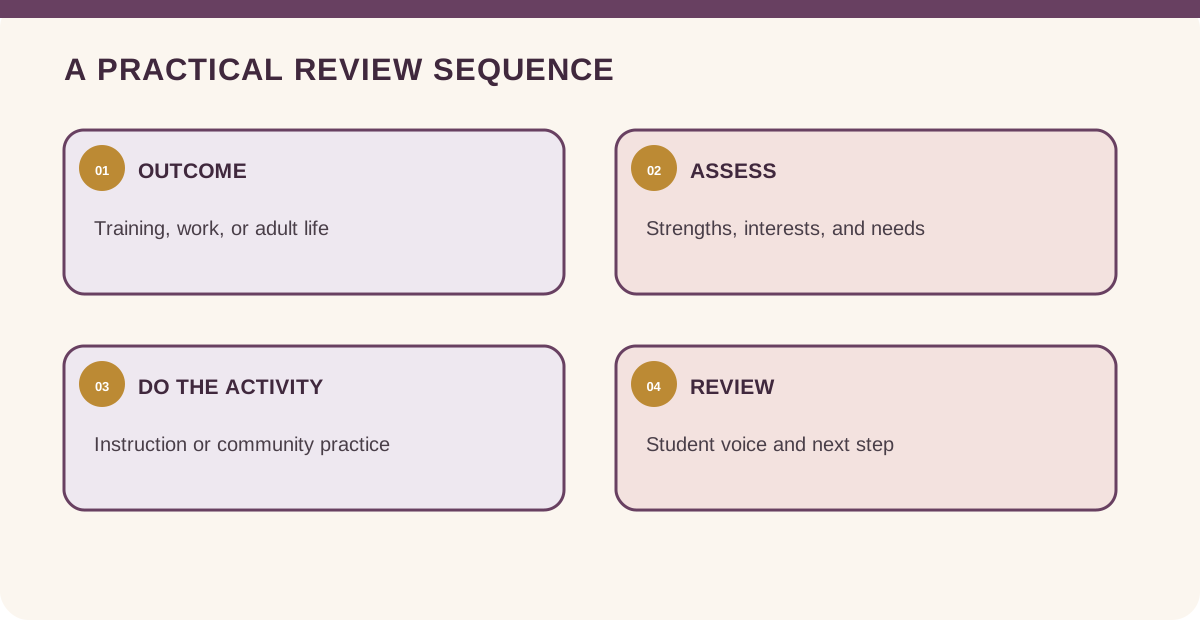
- ListenGather the student's preferences and interests.
- AssessUse age-appropriate formal and informal information.
- PlanName a relevant activity and responsible person.
- ReviewCheck participation, progress, and next opportunity.

Service examples organized by outcome area
The examples below are planning ideas, not a required federal checklist. Use only activities that fit the student’s individualized assessment, postsecondary goals, local programs, and available partners. Specify the person or agency responsible and the expected timing in the IEP or related transition plan as required locally.
| Post-school outcome | Possible transition service | Possible annual skill goal |
|---|---|---|
| Postsecondary training | Compare certificate programs, visit a training site, practice completing an application, or meet with an accessible career/college advisor | Given two program descriptions, the student will identify required courses, support contacts, and one next application step using a checklist |
| Employment | Conduct job exploration, arrange a work-based learning experience, practice job tasks with feedback, or coordinate vocational rehabilitation discussion with consent | During a simulated or supervised work routine, the student will follow a task sequence and request clarification using the agreed communication method |
| Independent living | Practice a relevant daily-living routine, compare support options, or learn to use a calendar, meal-planning tool, or money-management system | Given a weekly routine and visual or digital planner, the student will prepare and check a set of agreed tasks using the defined rubric |
| Community participation | Practice a route with safe travel instruction, learn how to access a library or recreation program, or explore community resources | Using the student’s travel support plan, the student will complete the defined route steps and seek help appropriately across planned practice sessions |
These examples intentionally avoid assuming that every student needs an independent-living goal, a job placement, or a particular agency referral. A student’s individualized plan might focus on supported employment, adult education, community participation, or a different pathway. The team should not narrow expectations because of disability stereotypes or a diagnosis label.
Write the activity so someone can coordinate it
For each transition activity, record enough detail that staff know what will happen. Identify the outcome area, activity, person responsible, approximate timeframe or frequency, and needed coordination. “Career counseling” may be too vague if no one knows who provides it or what the student will do. A more actionable entry could name a staff member to support two job-interest interviews and one community-based job exploration activity during the semester, if that matches the student’s plan and district format.
Check that the activity is truly a service or coordinated activity and not only a desired end state. “Student will work after graduation” is an outcome, not a school activity. “Student will practice completing an application with accessible technology and meet with the transition coordinator to identify local work-based learning options” describes actions that could be scheduled and reviewed. Do not overpromise a placement the district cannot guarantee; describe the school’s planned activity and any outside-agency coordination accurately.
Make the connection visible. A small planning map can use three columns: postsecondary goal, transition service, and current-year annual goal. The service should move toward the post-school outcome; the annual goal should teach a measurable skill that helps the student participate in that service or reach the outcome. If a row does not connect, ask whether the activity is relevant or whether an important barrier has been missed.
Coordinate agencies carefully and protect student choice
Some students may benefit from collaboration with vocational rehabilitation, adult service providers, community colleges, workforce programs, or other agencies. Begin early enough to learn eligibility, application, documentation, and waiting-list rules, but do not assume an outside agency will provide a service before it agrees to participate. Invite an agency representative to an IEP meeting only with the parent’s or adult student’s required consent under IDEA and applicable procedures.
Coordinate responsibilities. The IEP can identify what the school will do, what an invited agency may contribute, and who will follow up. If a participating agency other than the public agency fails to provide a transition service described in the IEP, IDEA requires the public agency to reconvene the IEP team to identify alternative strategies to meet the transition objectives. This does not mean the school can promise every adult-service outcome; it means the team should plan for coordination and address a missed IEP transition service through the required process.
Respect the student’s choices and privacy. Explain why information is being shared, with whom, and for what purpose. Follow IDEA’s age-of-majority notification requirements and state transfer-of-rights rules. Keep sensitive documents in approved channels, and do not distribute a student’s full IEP to community partners when a limited authorized summary is sufficient.
| IEP element | Purpose | Example |
|---|---|---|
| Postsecondary goal | What the student expects after school | Attend a career-training program |
| Transition service | Activity supporting that outcome | Visit a program and compare supports |
| Annual goal | Measurable school-year skill | Use a checklist to identify required steps |
Plan instruction and practice across real settings
Transition skills often need practice beyond a worksheet. Depending on the goal, instruction may occur at school, in a community setting, or through an accessible simulation. A student learning to ask for accommodations might practice with a school counselor first, then role-play a training-program contact. A student learning a travel routine could practice on a safe, planned route with the appropriate instruction and supervision. Activities must be individualized and consistent with family consent, district safety policies, and the student’s IEP.
Generalization does not mean testing the student in unsafe or unsupported conditions. The plan should identify the access supports, prompts, communication tools, and safety steps that make the experience appropriate. Record what the student did and what support was needed. If the activity changes, label the difference rather than scoring it as though it were the same condition.
Plan around the school calendar and partner availability. Application deadlines, transportation, job-site schedules, and adult-agency eligibility windows may not align with annual IEP dates. Assign a person to check each dependency and communicate early if an opportunity is unavailable. If the student’s interests change, return to assessment and update the plan through the team process rather than forcing an outdated pathway.
Measure participation and progress without reducing the person to a checklist
Data can show whether a planned activity occurred, whether the student could access it, what skill was demonstrated, and what support was needed. Track more than a yes/no completion box when the annual goal measures a skill. A work-based learning log might include task steps completed, prompts, accommodations used, student feedback, and the next practice target. A self-advocacy goal might use a rubric for identifying a need, selecting a communication approach, and following up.
Do not score adult satisfaction, eye contact, or compliance as a proxy for readiness unless that construct is explicitly relevant and defined. Transition planning should build agency and participation, not demand that a student appear “typical.” Ask the student what worked, what felt inaccessible, and what support would make the next attempt more useful.
At each review, check if the activities happened, if agency roles were clear, if the student’s post-school goals remain current, and if the annual goals still prepare for those outcomes. IDEA requires review and revision as appropriate; local forms may add fields. Use current information rather than copying an old transition grid forward without examining it.
Quick audit of an IEP transition page
- Are postsecondary goals based on age-appropriate transition assessment?
- Are training/education, employment, and where appropriate independent-living outcomes addressed?
- Does each service describe an actual activity, responsible person, and timeframe?
- Can the student access and meaningfully participate in the activity?
- Are school and agency responsibilities distinguished, with required consent for invitations?
- Does each annual goal build a skill connected to a post-school outcome?
- Are state age requirements and district procedures checked?
Strong transition services are coordinated, concrete, and rooted in what the student says and does. The IEP should give the student and family a usable picture of what the school year will make possible and how those activities connect to adult life.
Sources checked
- eCFR — Transition services, 34 CFR §300.43
- eCFR — IEP transition content and services, 34 CFR §300.320(b)
- eCFR — Review of IEP and failed transition services, 34 CFR §300.324(b)–(c)
- IRIS Center — Transition Assessments and Postsecondary Goals
- U.S. Department of Education — A Transition Guide to Postsecondary Education and Employment
- Colorado Department of Education — Quality Secondary IEP Goals: Transition Service Examples
Questions teachers ask
What are examples of IEP transition services?
Examples may include instruction, related services, community experiences, job exploration, work-based learning, postsecondary program visits, self-advocacy instruction, or daily-living skill practice when each fits the student’s assessed needs and goals.
Are transition services the same as postsecondary goals?
No. A postsecondary goal describes what the student expects to do after high school. A transition service is an activity that helps the student move toward that outcome; an annual goal measures a skill learned during the current IEP year.
At what age must transition planning appear in an IEP?
IDEA requires the content no later than the first IEP in effect when the student turns 16, or younger if the team determines appropriate. States may require an earlier age, so check current state rules.
Can an outside agency be invited to the IEP meeting?
Yes, when the parent or adult student provides required consent under IDEA and applicable procedures. Do not assume an agency has agreed to provide a service until responsibilities are confirmed.