BIP Data Collection Examples: Track Behavior, Replacement Skills, and Plan Fidelity
Choose data measures that match a behavior intervention plan, document replacement skills and staff implementation, and use patterns to guide team review.

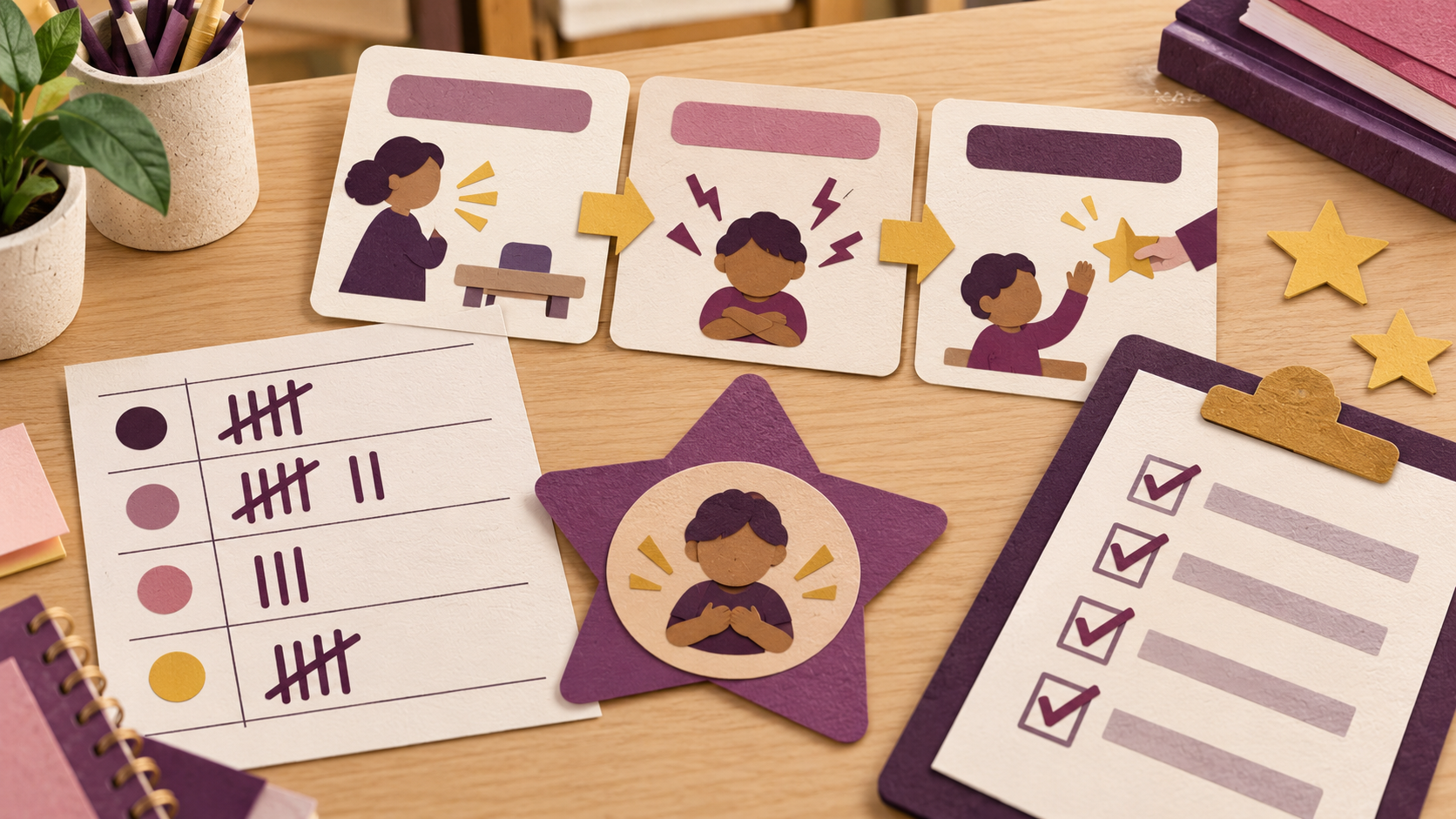
Behavior intervention plan data should answer a decision question. Is the behavior changing? Is the student using a replacement skill? Are the planned supports being implemented as intended? A single tally of “good” and “bad” behavior rarely answers all three. A practical BIP data system defines what staff will observe, when they will record it, how the record will be reviewed, and what response follows when the plan is not working or cannot be implemented.
Begin with the behavior and the plan’s purpose
Use the behavior definition already developed through the school’s assessment and planning process. It should describe observable actions, start and stop rules, and boundaries that help two staff members recognize the same event. “Disruptive,” “defiant,” or “upset” are interpretations, not precise data definitions. A description such as “calls out above conversational volume while another person is speaking, without an assigned turn” is more observable; refine it to fit the actual student and context.
Review the BIP’s hypothesis and strategies before selecting a form. A function-based plan may include prevention steps, environmental adjustments, a replacement skill to teach, reinforcement or acknowledgment, and a response plan. Data should connect to those plan components. If a student is learning to request help to avoid a difficult task, tracking only how often the student leaves the room misses whether the taught request is increasing and whether help is available when requested.
The U.S. Department of Education’s 2024 guidance describes FBAs as a way to understand factors contributing to behavior and discusses behavioral plans with prevention, skill teaching, reinforcement, implementation responsibilities, staff training, and progress evaluation. For a student with a disability whose behavior impedes their learning or that of others, IDEA requires the IEP team to consider positive behavioral interventions and supports and other strategies. Individual legal obligations depend on the facts and applicable rules; a classroom data sheet does not determine those obligations.
Match the measure to the behavior
Choose a measure that fits the behavior’s observable form. Frequency works for discrete events with clear boundaries. Duration may fit a behavior that continues over time. Latency can measure time from a defined cue to a response. Interval or momentary time sampling may be practical for frequent behavior, but the team should understand that sampling estimates occurrence rather than recording every event. Permanent-product data can work when a visible result reliably represents the skill or behavior.
| Question | Possible measure | Example of a clear record |
|---|---|---|
| How often does a discrete event occur? | Frequency per defined class period or opportunity | Number of times the student leaves the assigned area during a 30-minute independent-work block |
| How long does an episode last? | Duration from defined start to defined end | Minutes between the first defined call-out and the plan’s end rule |
| How quickly does the student begin a response? | Latency after a specific cue | Seconds from the agreed visual direction to beginning the first task step |
| Is the student using the replacement skill? | Count or percentage of defined opportunities | Help request used independently in 4 of 6 documented difficult-work opportunities |
| Was the plan carried out? | Brief implementation checklist | Visual choice offered before the transition; planned response delivered after the request |
These are examples, not universal coding rules. A measure should be safe, feasible, and proportionate to the decision. If the behavior is rare but serious, frequency alone may not capture risk or context. If staff cannot reliably tell whether an event meets the definition, train and calibrate before interpreting trends. Do not collect a burdensome data stream nobody can sustain.
| Data stream | Question answered | Example record |
|---|---|---|
| Behavior | How often or how long? | Events per defined class period |
| Replacement skill | Was the taught response used? | Requests per relevant opportunity |
| Fidelity | Were plan steps available? | Choice offered before transition |

Track replacement behavior and access to the skill
A BIP is intended to support learning and participation, not only suppress a behavior. Identify the replacement response the student is being taught and count opportunities to use it. The replacement should be functionally relevant, accessible, and efficient enough to work in the situation. A student asking for a break, requesting help, using AAC to communicate “wait,” or following a taught transition routine may need different measures and supports.
Distinguish “no behavior occurred” from “the student used the replacement skill.” Both can be useful outcomes, but they are not the same. Also distinguish “no opportunity” from “did not respond.” If an adult gave no planned choice or the communication device was not available, the student did not have the planned chance to demonstrate the skill. Record what happened without assigning blame or inferring intent.
Measure the denominator when an opportunity-based goal is used. “Three requests” means little without knowing whether there were three or twenty opportunities. A percentage can be useful if staff define what counts as an opportunity, what counts as independent use, and which prompts are allowed. Include prompt level when independence matters; otherwise staff may celebrate a prompted response as though it were spontaneous.
Capture context without turning notes into judgments
A brief antecedent-behavior-consequence note can help the team see patterns: what happened immediately before, the observable behavior, and what followed. Keep entries concise and factual. “The independent writing task was presented; the student pushed the paper away and left the seat; the teacher removed the worksheet and spoke with the student” records events. “Student was manipulative to get out of work” assigns motive beyond the observation.
Context fields may include activity, transition, task difficulty, people present, time, environmental conditions, communication access, and relevant plan supports. Do not ask staff to record every possible life detail. Collect only information that helps evaluate the hypothesis or plan. Health, family, and disability information must remain in approved secure systems and be shared only with authorized personnel.
Be cautious when comparing days. A 20-minute center rotation is not directly comparable with a 50-minute assembly. Note the amount of time observed, task, number of opportunities, and major schedule changes. Report rates using the right denominator when appropriate—per class period, per hour, or per opportunity—rather than raw totals that rise simply because observation time increased.
Check implementation fidelity alongside student outcomes
If behavior changes little, first ask whether the plan was actually available and implemented. A brief fidelity checklist can record whether staff completed the plan’s key actions: prepared the visual schedule, provided the specified choice, prompted the replacement response as planned, reinforced the communication, and used the response procedure consistently. Tailor the list to the actual BIP; do not invent steps or use fidelity scores to punish staff.
Student data without implementation data can be misleading. A flat behavior trend may mean the strategy is ineffective, or it may mean that staff lacked materials, coverage, training, or time to use it. Conversely, a reduction in behavior does not show which element caused the change. The team should interpret outcome and implementation evidence together and consider other relevant changes in the setting.
Make the fidelity form quick enough to complete during normal routines. A yes/no checklist for a few high-impact steps, plus a factual note when a step was not possible, may be more useful than a long rating scale. Ask more than one implementer when the plan spans classes or settings. A short calibration conversation can expose ambiguous wording before it becomes a data-quality problem.
Use an example data set to guide a question, not a verdict
Suppose a fictional student’s BIP targets leaving the work area during independent writing and teaches the student to request a short break. In week one, staff observe six events across five 30-minute blocks and record one independent break request across four opportunities. The visual choice was available in three of the five blocks. In week two, staff observe four events across five blocks, three independent requests across five opportunities, and the choice available in all five blocks. This suggests a pattern worth discussing, but two weeks do not prove causation or establish a fixed decision threshold.
Before interpreting the difference, check whether tasks and observation lengths were comparable, whether the same staff used the definition, whether the student had similar opportunities, and whether another environmental change occurred. The data may support a question such as: “Is the replacement request becoming more available when staff offer the planned choice?” They do not establish that the plan has succeeded, that the student no longer needs support, or that one strategy caused the change.
Build a short review graph or table with dated observations, units, missing sessions, and plan-fidelity notes. Label a week with no observation as missing rather than zero. Keep the underlying records so the team can inspect raw data rather than relying only on an average. If the team sets a decision rule, document that rule in advance and apply it consistently; no universal IDEA percentage tells every BIP team when to revise.
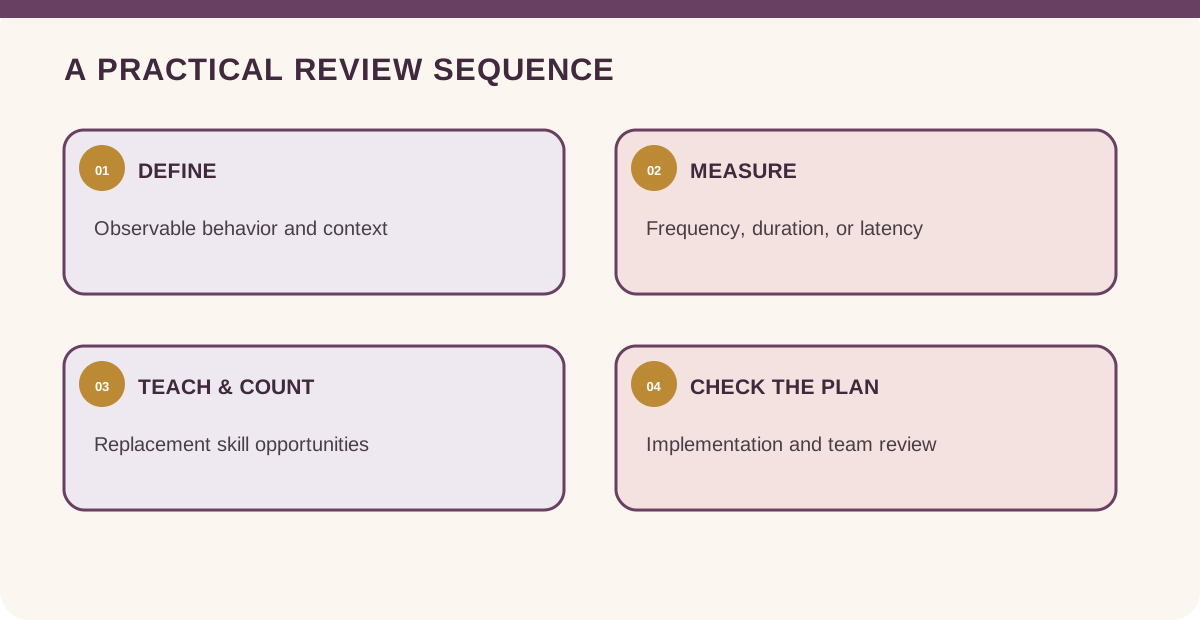
- DefineAgree on observable behavior and response rules.
- CollectRecord comparable opportunities, outcomes, and missing sessions.
- CheckReview plan implementation and student access.
- DecideBring the pattern and a clear question to the team.
Decide when the team should review the plan
Bring data to the responsible team when the behavior is worsening, the replacement skill is not becoming usable, safety concerns emerge, the plan cannot be implemented, staff disagree about the hypothesis, or the student’s needs or circumstances change. Also review when the plan’s own schedule says to evaluate it. Use district crisis and safety procedures for urgent situations; do not wait for a routine graph review when immediate support is needed.
Prepare the evidence in a compact packet: the plan’s operational definition, behavior measure, replacement-skill measure, fidelity summary, context notes, and the team’s decision question. Include the student’s perspective when appropriate and accessible. Ask whether additional assessment, staff training, environmental changes, or revisions to the plan should be considered. A teacher should not unilaterally change a BIP that is part of the IEP.
IDEA has specific discipline requirements in certain circumstances, including a manifestation determination following a disciplinary change of placement and steps involving an FBA/BIP when a behavior is determined to be a manifestation, subject to the regulatory conditions. This article is not a substitute for those rules or state discipline procedures. Do not generalize that every suspension requires a new FBA or that one data form decides a placement or disciplinary question.
Privacy, fairness, and the student’s dignity
Use neutral language and examine whether staff perception could bias what gets counted. Different adults may interpret the same movement, tone, or communication differently. Define observable actions, train data collectors, and periodically compare scoring. Focus on environmental conditions and skills the school can support rather than labeling the student’s character.
Collect the minimum data needed for the educational decision. Do not place identifiable behavior records in public spreadsheets, personal cloud accounts, or broad staff messages. Follow district retention and access rules. When using examples for training, use fictional data or approved de-identified material.
Include the student as a partner where appropriate. Explain the plan in accessible language, ask which supports feel helpful, and make sure the replacement skill respects communication and self-advocacy. The objective is to create a more supportive environment and teach useful skills, not to demand silence or compliance regardless of context.
Practical BIP data checklist
- Does the definition describe an observable action with start and stop rules?
- Does the chosen measure fit frequency, duration, latency, opportunity, or another defined question?
- Are observation time and opportunities recorded so scores can be compared fairly?
- Is replacement-skill use measured separately from reduction in behavior?
- Does the team know whether key BIP steps were implemented?
- Are missing sessions visibly marked and student data stored securely?
- Is there a named person and schedule for review, with an escalation route for urgent concerns?
Good BIP data are small, interpretable, and tied to action. They show what the student did, what support was in place, whether the replacement skill was available, and what the team should examine next. That makes review more humane and more useful than a running tally without context.
Sources checked
- U.S. Department of Education — Using Functional Behavioral Assessments to Create Supportive Learning Environments (2024)
- eCFR — IEP team consideration of behavior, 34 CFR §300.324(a)(2)(i)
- eCFR — Discipline procedures, 34 CFR §300.530
- Texas Education Agency — Behavior Intervention Plans
- California Positive Environments, Network of Trainers — BIP Implementation and Fidelity
- IEP Progress — Behavior Data Collection for a BIP
Questions teachers ask
What data should be collected for a BIP?
Collect what answers the plan’s decision questions: a defined measure of the target behavior, opportunities and use of the replacement skill, relevant context, and a brief check that key plan steps were implemented.
Should staff collect frequency or duration data?
Choose the measure that fits the behavior and the question. Frequency fits discrete events; duration fits sustained episodes. Latency, opportunity-based measures, or sampling may fit other targets when clearly defined.
Does a BIP need implementation-fidelity data?
Implementation information helps the team interpret student outcomes. Follow the BIP and district process; a short checklist of the plan’s key steps can reveal whether the support was available as designed.
Does every suspension require a new FBA?
No. IDEA discipline requirements depend on specific circumstances, including whether there is a disciplinary change of placement and the manifestation determination. Follow the regulation and district procedures for the individual case.