How to Write a Measurable IEP Goal With a Baseline, Criterion, and Timeline
Build an annual IEP goal from baseline data, a clearly observable skill, a measurement method, a success criterion, and an explicit timeline.
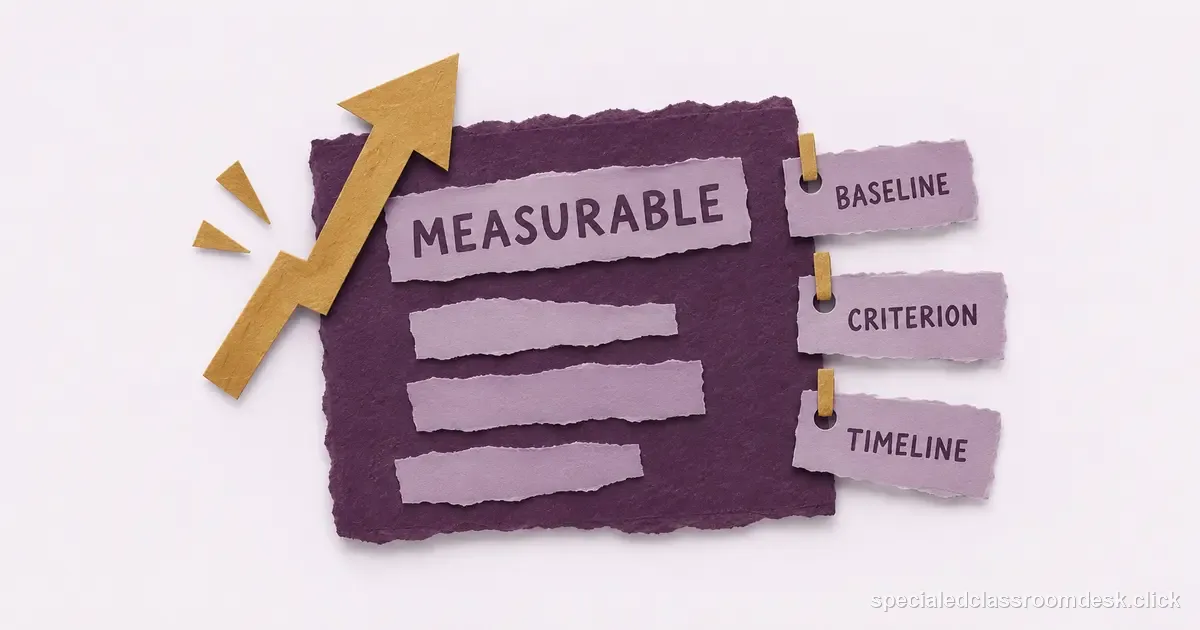
A measurable annual goal is not made measurable by adding “80% accuracy” to the end of a sentence. The useful question is whether two staff members could watch the same student, collect data the way the IEP describes, and reach roughly the same conclusion about progress. Start with the current performance, name the behavior that will change, decide how it will be sampled, and only then choose the criterion.
Start at the baseline, not at the hoped-for percentage
Pull the most recent data that actually matches the skill. If the concern is solving two-digit subtraction with regrouping, a broad math benchmark score is weak baseline evidence because it mixes many skills. A better baseline might be: on three probes of ten two-digit subtraction problems requiring regrouping, Maya solved 4, 5, and 4 correctly without a calculator. That gives the team a current level of about 43% across the sampled items and, more importantly, defines the exact task.
Baseline data also exposes measurement problems before they are locked into the IEP. If one probe allowed a number line and another did not, the team should decide whether that support is part of the target condition. If performance swings widely by problem type, the goal may need a narrower skill or a more representative probe.
Write the behavior so a substitute could score it
Replace vague verbs such as “understand,” “improve,” and “demonstrate knowledge” with an observable response. A student can read words aloud, write a paragraph, initiate a request, follow a three-step direction, solve equations, identify emotions, or use a taught break routine. The wording should tell the data collector what counts as an opportunity and what counts as a successful response.
A practical annual-goal sentence often contains five parts: condition, learner, observable behavior, criterion, and measurement window. For example: “Given ten mixed two-digit subtraction problems requiring regrouping and access to the classroom number line, Maya will solve at least eight correctly on three consecutive weekly probes by the annual review date, as measured by curriculum-based computation probes.” This is not the only acceptable syntax; it is simply a sentence that can be implemented consistently.
- Match the baselineUse the same skill and conditions for the current level and annual target.
- Name the responseDescribe an observable action rather than “understand” or “improve.”
- Choose the measureState how responses or opportunities will be sampled.
- Define successSet a criterion that fits the skill and the cost of an error.
- Set the windowSeparate collection cadence, mastery stability, and annual endpoint.

Make the criterion match the cost of an error
There is no federal rule that every IEP goal must use 80%. Pick a criterion that fits the skill and baseline. Eighty percent may be reasonable for a developing academic skill, yet it would be a poor mastery definition for a safety routine where one missed response matters. A fluency goal may use rate plus accuracy. A social communication goal may use successful opportunities across different settings. A writing goal may be better scored with a short analytic rubric than a raw percentage.
Check whether the criterion can be reached by accident or by avoiding hard items. “Four of five opportunities” is stronger when the opportunities are defined: during naturally occurring peer-work situations, when a peer disagrees or requests a turn, the student uses one of the taught responses without adult verbal prompting.
Choose a timeline you can actually monitor
The annual review date is the endpoint, but teachers need a measurement cadence that can reveal a stalled trend before the year is over. A weekly academic probe can make sense for a skill that changes rapidly and can be sampled in minutes. A complex functional routine might be summarized across several naturally occurring opportunities each week. The IEP should say how progress is measured and when periodic reports will be provided; the local calendar determines the exact reporting dates.
Do not confuse the monitoring frequency with the mastery rule. “Three consecutive probes” is a stability check. “By the annual review date” is the timeline. “Weekly” tells staff how often data are collected. Keeping those ideas separate makes later data reviews much easier.
A complete example, then the stress test
Annual goal: Given an unfamiliar grade-level passage of comparable difficulty, Jordan will read at least 105 words correct per minute with at least 97% word-reading accuracy on three consecutive curriculum-based reading probes by the annual review date.
Stress-test the goal before the meeting ends. Where do the passages come from? Who times the reading? Are self-corrections counted consistently? What happens if rate rises while accuracy drops? If those questions cannot be answered, the goal may look precise while still producing unusable data.
Keep the goal connected to instruction
A well-written target does not prescribe every teaching move, but it should be close enough to the instructional need that the teacher can act on the data. If the student's error analysis shows weak vowel patterns, instruction can address decoding while the fluency probe tracks transfer. If subtraction errors are mostly regrouping mistakes, the computation data should be separated by error type rather than filed as a single percentage.
For a searchable bank of measurable IEP goals by subject and grade band, see: iepgoalwriter.pro. Use examples as drafting material, then replace the baseline, conditions, measurement method, and criterion with data that belong to the individual student.
If staff cannot label the columns without inventing definitions, clarify the behavior, support, denominator, and mastery rule before finalizing.
Check whether short-term objectives are required
An annual goal and a short-term objective are not interchangeable. IDEA requires benchmarks or short-term objectives for a student who takes an alternate assessment aligned to alternate academic achievement standards; it does not make objectives a universal requirement for every IEP goal. Check the current state or district form for how any required objectives must be recorded, and connect each one to the annual goal and the student's present levels. See 34 CFR §300.320(a)(2).
What to fix before you call the draft finished
Read the goal once as the case manager and once as the staff member who will inherit it next semester. Remove undefined terms such as “minimal prompts” unless the prompt level is specified. Check that the baseline and goal measure the same construct. Make sure the success rule is neither so low that current performance already meets it nor so high that no reasonable instructional response could reach it. Finally, make the data source easy enough to collect that the progress-monitoring plan survives a busy school week.
Sources checked
Questions teachers ask
Does IDEA require 80% accuracy in an annual goal?
No. IDEA requires measurable annual goals but does not set one universal mastery percentage. The IEP Team chooses a criterion that fits the student, skill, baseline, and measurement method.
Can a goal use a rubric instead of a percentage?
Yes, when the rubric has defined scoring criteria and can show change reliably. Written expression is a common example where an analytic rubric may be more informative than a single percent correct.
Should the baseline be written inside the goal sentence?
It does not have to be in the same sentence, but the IEP should make the current level clear enough that the annual target can be interpreted against it.
How many data points prove mastery?
There is no single federal number. Teams often use repeated data points or consecutive probes to avoid calling one unusually strong performance mastery.