Reading Comprehension IEP Goal Examples: Measure Retell, Main Idea, and Inference
Build a reading comprehension IEP goal from a specific text task, observable response, baseline, scoring rule, and comparable progress-monitoring plan.


A useful reading-comprehension IEP goal names what the student will do with text and how the team will recognize a successful response. “Will improve comprehension” is too broad to guide instruction or consistent progress monitoring. A goal focused on retelling, identifying a main idea with supporting evidence, or drawing an inference can be measured when the team defines the text, response conditions, scoring rule, and baseline.
Decide which comprehension behavior the data will represent
Comprehension includes several related processes. A student may understand a story sequence but struggle to identify the central idea in an informational passage. Another may locate stated facts yet have difficulty connecting clues to an inference. A broad score that combines vocabulary, decoding, memory, background knowledge, and written expression can hide the skill the team intends to teach. Start with current evaluation and classroom information, then select one observable target that addresses the student’s documented need.
Possible response targets include retelling key events in order, stating a passage’s main idea and citing details, answering literal and inferential questions, summarizing an informational section, or using a taught fix-up strategy when meaning breaks down. These are examples rather than a menu that every student needs. The student’s language, communication method, grade-level access, and disability-related needs should shape the task and response format.
Research guidance supports explicitly teaching comprehension-building practices such as building knowledge, asking and answering questions, determining the gist of a short section, and monitoring understanding. Those instructional recommendations do not prescribe an IEP goal formula or mastery percentage. The team should select instruction and measurement based on the student’s profile and local tools, not copy a generic goal bank without checking fit.
Build the goal from baseline evidence
Collect a few recent samples that match the kind of text and response the goal will use. Record passage type and approximate difficulty, whether the text was read independently or accessed through text-to-speech or adult reading, question type, prompt level, and the scoring method. If decoding is still developing, a comprehension measure that requires independent decoding may unintentionally measure both decoding and understanding. The team may need a specific access condition to isolate comprehension while continuing to teach reading skills.
Baseline should tell the reader what the student can do now. For example: “Across three unfamiliar fourth-grade informational passages read aloud using the student’s listed text-to-speech support, the student stated the topic but identified the central idea and two relevant details together on 1 of 5 scored opportunities.” That statement defines the task, support, sample, and current response. Replace all elements with actual student evidence; do not use sample numbers as a benchmark.
Decide whether scoring is item-based, rubric-based, or opportunity-based. A short analytic rubric can separately score main idea, supporting evidence, and explanation. A retell measure can mark whether key events are included and in order. If using a percentage, define the numerator and denominator. “80% comprehension” is not sufficiently specific unless the team knows which items, passages, and response rules make up that percentage.
| Target | Student response | Useful scoring evidence |
|---|---|---|
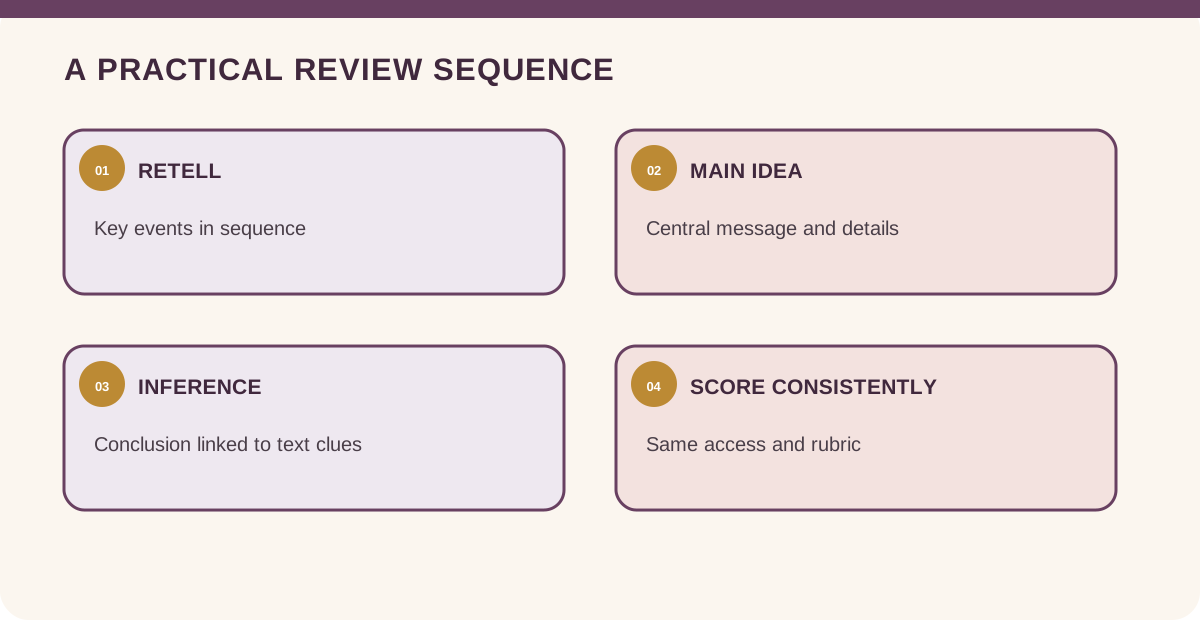
| Retell | Key events in sequence | Sequence and inclusion of key events |
| Main idea | Central idea with details | Idea plus relevant textual support |
| Inference | Conclusion and clue | Plausible answer linked to text evidence |

Three goal patterns with measurable conditions
The examples below illustrate structure, not recommended targets or state requirements. They use fictional learners and numbers only. A real IEP team should set the condition, criterion, and timeline from current data and the student’s instructional need.
| Focus | Illustrative goal structure | Measurement detail to define |
|---|---|---|
| Retell | Given an unfamiliar narrative passage at the instructional text level and the listed access supports, the student will retell the central problem and at least three key events in order on the team-defined number of comparable probes by the annual review date. | What counts as a key event; oral, AAC, or written response; prompt level; rubric and passage comparability |
| Main idea and evidence | After reading or listening to an unfamiliar informational passage under the stated conditions, the student will state its central idea and identify two relevant details using a scoring rubric across the required samples by the annual review date. | Rubric dimensions; whether details must be quoted or paraphrased; reading access method; how alternate forms are selected |
| Inference | Given a short passage and the listed visual organizer if specified, the student will answer an inference question and cite a clue from the text on the defined proportion of comparable opportunities by the annual review date. | What counts as a valid inference and text clue; question construction; prompt level; denominator |
Read each sentence as a data collector. Could two staff members tell whether an opportunity happened? Could they score the same response similarly? Would the student be able to demonstrate comprehension using the communication and access supports named in the IEP? If not, add detail or choose a narrower response. The goal should guide teaching without scripting every lesson.
Keep reading access separate from comprehension scoring
Text difficulty and access matter. A student may decode slowly yet understand a complex passage when it is read aloud; another may read accurately but lose meaning across a long text. The team should be explicit about whether the goal measures comprehension after independent reading, listening to text, supported reading, or a specified mix. Those are different conditions and may answer different educational questions.
Use grade-level content access where appropriate and preserve the construct the goal measures. If the student uses text-to-speech as an accommodation, include it as part of the goal condition when the team intends to measure comprehension with that support. If the team is measuring independent decoding, do not add a reading-aloud support that changes the target. These choices should reflect the current IEP and evaluation data, not be made ad hoc by the person administering a probe.
Also consider response mode. Oral language, AAC, pointing, sorting, and writing can each introduce demands unrelated to comprehension. If a student can select a main idea accurately but cannot yet write a paragraph, a written response alone may understate comprehension. A clear goal can specify an accessible response method while the IEP separately addresses written expression or communication where needed.
Use a scoring guide that captures meaning, not just keywords
For a main-idea task, a rubric might distinguish (1) identifies the topic, (2) states the central idea, (3) selects relevant supporting details, and (4) explains how a detail supports the idea. For inference, it may score whether the answer is plausible and whether the student links it to a textual clue. For retell, it may score sequence, key events, and causal relationships. Keep the rubric short enough that staff can use it consistently.
Do not require an exact sentence from the passage when paraphrasing demonstrates the intended skill. Do not award credit for a vague answer simply because it contains a keyword. If the student uses an AAC device or another communication mode, agree on scoring rules before monitoring begins. Give staff a few anchor examples, including an acceptable response and a near-miss, then calibrate scoring occasionally.
Probe design can distort results. Repeating the same story may test memory; switching from short narrative passages to dense science articles may change difficulty; giving increasingly leading prompts may inflate scores. Use comparable alternate forms, document any unusual condition, and avoid interpreting a score change until the team checks what changed in the task or administration.
Monitor progress and connect it to instruction
Choose a schedule that can detect change and is feasible for staff. The IEP should state the measurement method and reporting schedule. A short weekly or biweekly sample may work for some skills; a broader rubric-based sample may need less frequent collection. Federal law does not prescribe one national frequency for every comprehension goal. Follow the IEP and local procedures, and make the measure frequent enough to guide instruction before the annual meeting.
Look beyond the total score. If a student identifies the topic reliably but selects unrelated details, instruction may focus on distinguishing central ideas from interesting facts. If literal understanding is sound but inferences are unsupported, teach the student to pair a plausible conclusion with a specific clue. If the student loses meaning midway, comprehension monitoring and fix-up routines may be more important than increasing passage length.
Progress monitoring is not the intervention itself. Record the result, identify the response pattern, and use that information with other instructional evidence. A flat score might reflect instruction, attendance, task mismatch, language demands, or inconsistent implementation; it does not diagnose a cause. If expected progress is not occurring, share the comparable evidence with the case manager and team for review.
- Set the accessRecord reading or listening supports.
- Choose a textUse comparable passages or alternate forms.
- Score the responseApply the same rubric and prompt rule.
- Review patternsUse item-level evidence to guide instruction.
Common goal-writing errors and repairs
- “Will improve reading comprehension”: name the response, such as retelling events or identifying a main idea with details.
- “Will answer comprehension questions with 80% accuracy”: define passage type, question types, denominator, access method, and sample rule.
- Combining unrelated skills: separate decoding, vocabulary, written response, and comprehension when each needs distinct instruction or measurement.
- Using grade level as the only condition: state passage source or difficulty rule and the allowed supports.
- Leaving “with minimal prompts” undefined: describe which prompts are allowed and how independence is scored.
- Choosing a goal-bank number without a baseline: use current samples and team judgment to set an individualized, meaningful criterion.
IDEA describes measurable annual goals and requires the IEP to explain how progress will be measured and when periodic reports will be provided. It does not endorse a single comprehension rubric or target percentage. Use the regulation as the framework, evidence-based reading instruction as a resource, and the student’s own present levels as the basis for the goal.
Family communication and next review
Translate the measure into observable examples when reporting progress. Instead of “comprehension at 70%,” explain that the student stated the central idea and selected relevant details on a certain number of comparable passages, with the stated access support. Share where the response is improving and which component still needs instruction. Keep the report brief, factual, and consistent with the IEP’s schedule.
At review, consider whether the goal remains useful, whether the measure is comparable, whether the supports reflect the student’s program, and whether new information from the family or student changes the team’s understanding. If the goal is met, use the evidence to discuss an appropriate next target. If progress is limited, review the instructional response and access conditions rather than merely raising the percentage or extending the deadline.
Reading comprehension is not a single score. A focused measurable goal helps the team teach and notice one meaningful change while protecting access to richer texts and the broader curriculum. The strongest goal connects a valid baseline, an observable response, an accessible condition, a consistent score rule, and a reporting plan.
Sources checked
Questions teachers ask
What is an example of a measurable reading comprehension IEP goal?
One pattern is: after reading or listening to an unfamiliar passage under specified access conditions, the student states the central idea and identifies two relevant details on the team-defined number of comparable samples by the review date. Set the criterion from the student’s baseline.
Should an IEP comprehension goal include a percentage?
A percentage can work when the task, denominator, scoring rule, and sample conditions are defined. It is not required for every comprehension skill; a concise rubric or opportunity-based measure may fit better.
Can text-to-speech be used during a comprehension goal probe?
If that support is part of the student’s IEP and the goal is intended to measure comprehension with it, specify the support as a condition and administer consistently. The team should distinguish comprehension from independent decoding.
Are reading comprehension goal-bank examples ready to copy?
Treat them as structure examples. Individualize the response, baseline, access condition, scoring rule, criterion, and timeline to the student’s current data and needs.