IEP Goal Met Before the Annual Review? How to Verify, Document, and Plan the Next Step
Confirm that early IEP goal mastery is supported by comparable evidence, communicate the result, and decide with the team whether an update is appropriate.


When a student appears to meet an IEP goal months before the annual review, the first task is to verify what “met” means in that particular goal. A strong score, one successful work sample, or a teacher’s impression may be encouraging, but mastery should be judged against the written condition, measurement method, criterion, and timeline. Once the evidence is checked, the case manager can communicate the result and ask whether a team review is appropriate.
Read the goal literally before celebrating a score
Pull the current signed IEP and identify each part of the goal: condition, observable response, prompt or support level, measurement unit, mastery criterion, number of consecutive samples, settings, and deadline. A goal may require 80% on three consecutive probes, independent use across two settings, or a rubric score with a defined number of work samples. If the team called the goal “met” based on one high score while the written criterion requires several samples, the documentation and conclusion do not yet match.
Check that the data represent the skill named in the goal. If the target is comprehension of grade-level informational text, a memorized story retell may not be equivalent. If the goal requires no more than one verbal prompt, count prompts rather than simply marking the answer correct. If a classroom assignment had access to a word bank, calculator, communication system, or adult cue, note whether that support is part of the goal’s condition. The IEP’s language governs the comparison.
Mastery also differs from being “on track.” A student can show a positive trend without reaching the mastery rule, and can meet a criterion on a narrow measure without yet generalizing the skill. Report the strongest conclusion the data support. If there is a mismatch or ambiguous criterion, take the issue to the case manager rather than retroactively changing how the goal is scored.
Use a mastery verification checklist
Before marking a goal complete, verify that the samples are valid, sufficiently numerous, and representative. Were they collected across the required time span? Did the same scoring rules apply? Were the passages or tasks comparable? Did the student complete them independently or with the allowed support? Did the student demonstrate the skill in every setting named? Did the team define “consecutive” and “opportunity” clearly enough for staff to apply them consistently?
| Question | Evidence to check | If it does not match |
|---|---|---|
| Was the criterion reached? | Raw scores and the written percentage, rate, rubric, or frequency rule | Continue collecting data; do not round up or reinterpret the threshold |
| Was the required number of samples reached? | Dated probes or observations, including gaps | Describe the result as promising or provisional, not verified mastery |
| Were conditions comparable? | Task difficulty, supports, setting, prompt level, timing, scoring | Label the difference and collect additional comparable samples |
| Does the skill generalize? | Evidence from the settings, people, and routines named in the goal | Identify where performance is strong and where evidence is still needed |
A simple example: an IEP goal says that a student will solve at least 8 of 10 mixed computation problems on three consecutive weekly probes with the listed calculator accommodation. The student scores 9/10 on a classroom quiz and 8/10 on a homework page. Those are useful work samples, but they do not automatically satisfy the goal if they are not comparable probes or are not weekly consecutive samples. The report can celebrate the performance and explain what remains to verify.
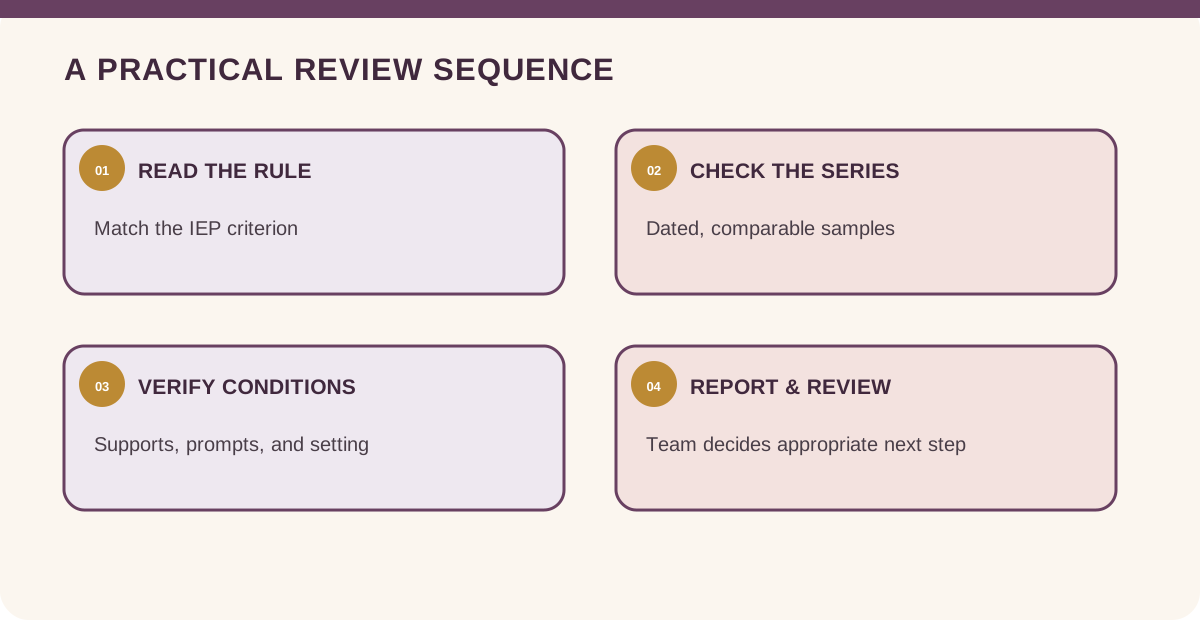
- Match evidence to the IEP criterion
- Check required number of comparable samples
- Confirm supports and prompt level
- Record dates, measure, and conditions

Document the result in a way another educator can understand
Keep the score record dated and tied to the goal’s measure. Include task source or form, number of items or opportunities, the student’s response, prompt level if relevant, supports used, scorer, and any unusual conditions. Avoid putting unnecessary sensitive details into an informal file. District-approved IEP and progress-monitoring systems should remain the official location for student information.
A useful progress note is brief but specific: “The goal’s criterion is 8 of 10 correct on three consecutive weekly probes. On Sept. 18, Oct. 2, and Oct. 9, the student scored 8/10, 9/10, and 8/10 on comparable forms using the listed calculator accommodation. The written criterion was met as of Oct. 9. The team will review whether the current target should be revised or whether another skill should be prioritized.” Adjust the language to the actual goal and local report form.
If a criterion was reached only in one routine, say so. “Mastery observed during the resource-room probe; the goal also names general education science, where no comparable observation has been collected” is clearer than a broad “goal met.” A qualified statement protects the accuracy of the record and tells the team what evidence remains useful.
Tell the family using the IEP’s reporting schedule
IDEA says the IEP must state how progress will be measured and when periodic reports will be provided. Use that schedule and district communication process. If the goal is reached between reporting dates, the case manager may share the dated results through the normal approved channel so the family is not left to infer the outcome from a future checkbox. Avoid promising a particular meeting or plan change before the responsible team has reviewed the information.
Translate technical details. Explain what the student did, what task was used, how many samples met the criterion, whether the stated support was in place, and what decision is being considered. A family may reasonably ask what happens next. Be clear that the team reviews the IEP periodically and revises it as appropriate; early mastery can be important information for that discussion, but it does not itself dictate one exact service, placement, or replacement goal.
Decide whether an earlier team review is appropriate
IDEA requires the public agency to ensure that the IEP team reviews the IEP periodically, but not less than annually, to determine whether annual goals are being achieved. The IEP is revised as appropriate to address lack of expected progress, reevaluation results, parent-provided information, anticipated needs, or other matters. The regulation sets an annual minimum and describes when revisions may be appropriate; it does not say every early mastery report automatically requires an immediate meeting.
Consider an earlier review when the student’s needs have changed, the current goal no longer targets an educationally relevant skill, the team needs to determine a next instructional priority, the goal is linked to supports that may need careful review, or parents or staff provide new information. If the goal is met but the annual IEP still describes an ongoing need, the team may need to consider what instruction, services, supports, and measurable goals are appropriate next. Do not simply delete the goal or reduce services on a teacher’s own authority.
Some districts and states have additional deadlines or procedures. The parent and public agency may agree in writing to amend an IEP without convening a full team meeting after the annual meeting, under the federal regulation and applicable local rules. That option is not a unilateral teacher edit; it requires the required agreement and documentation. When there is uncertainty about meeting timing, consult the district’s special education administrator or procedural safeguards contact.
Plan the next instructional target without racing ahead
Early mastery can signal that instruction was effective, the target was appropriately ambitious, or that the student is ready to apply the skill in a broader context. It can also reflect a narrow probe, repeated practice with identical items, easier-than-usual conditions, or an inaccurate scoring rule. Review what the evidence says before deciding that the next goal should simply be a higher number.
Ask what meaningful skill is next and what supports make access possible. A student who reads words accurately may need comprehension or fluency work; a student who independently uses a break strategy in one room may need practice across transitions. The next target should grow from present levels, the student’s needs, and team input. Avoid creating a harder goal solely to keep a data sheet active.
Maintain instruction and supports while the team decides. A met annual goal does not, by itself, cancel the rest of the IEP or justify an informal change to services, accommodations, or placement. If the IEP team later revises the plan, follow the district’s notice, consent, meeting, amendment, and documentation requirements. Keep the current plan as the source of implementation instructions until an authorized update takes effect.
- ConfirmCheck the goal rule and valid dated samples.
- CommunicateShare what the evidence shows and its limits.
- ReviewThe team considers whether revision is appropriate.
- ContinueImplement the current IEP until an authorized change takes effect.
Common documentation mistakes to avoid
- Calling one assignment mastery: align the evidence with the goal’s planned measure and sample rule.
- Changing the rule after seeing scores: apply the criterion written in the IEP or ask the team to clarify it prospectively.
- Confusing a progress update with an amendment: a report documents evidence; a plan change uses the required team or written-agreement process.
- Stopping supports immediately: continue implementing the current IEP unless an authorized change takes effect.
- Reporting only “met”: include the date, measure, conditions, and evidence that support the status.
- Assuming goal mastery proves all related needs are resolved: review present levels, generalization, anticipated needs, and the family’s information.
A careful mastery note is both good instruction and good communication. It recognizes the student’s accomplishment, shows how the conclusion was reached, and gives the IEP team a useful basis for deciding what should happen next.
Sources checked
Questions teachers ask
Does a goal being met early require an IEP meeting right away?
Not automatically under the federal review rule. IDEA requires periodic review at least annually and revision as appropriate. Follow state and district procedures and consider an earlier review when needs or the plan warrant it.
Can a teacher stop an accommodation once the student meets a goal?
No. Continue implementing the current IEP unless an authorized change takes effect through the applicable team or written-amendment process.
How many scores prove that an IEP goal is met?
There is no single federal sample count for every goal. Apply the criterion and measurement rule written in the student’s IEP, including any consecutive-sample or setting requirements.
Can a parent and school amend the IEP without a full meeting?
After the annual IEP meeting, IDEA permits the parent and agency to agree in writing to make amendments without convening the full team, subject to the regulation and local procedure. It is not a unilateral teacher decision.