When an IEP Goal Is Not Making Progress: What to Check Before the Next Reporting Period
Use a stalled IEP goal to inspect measurement, attendance, instructional delivery, error patterns, supports, and whether the team needs to reconvene.

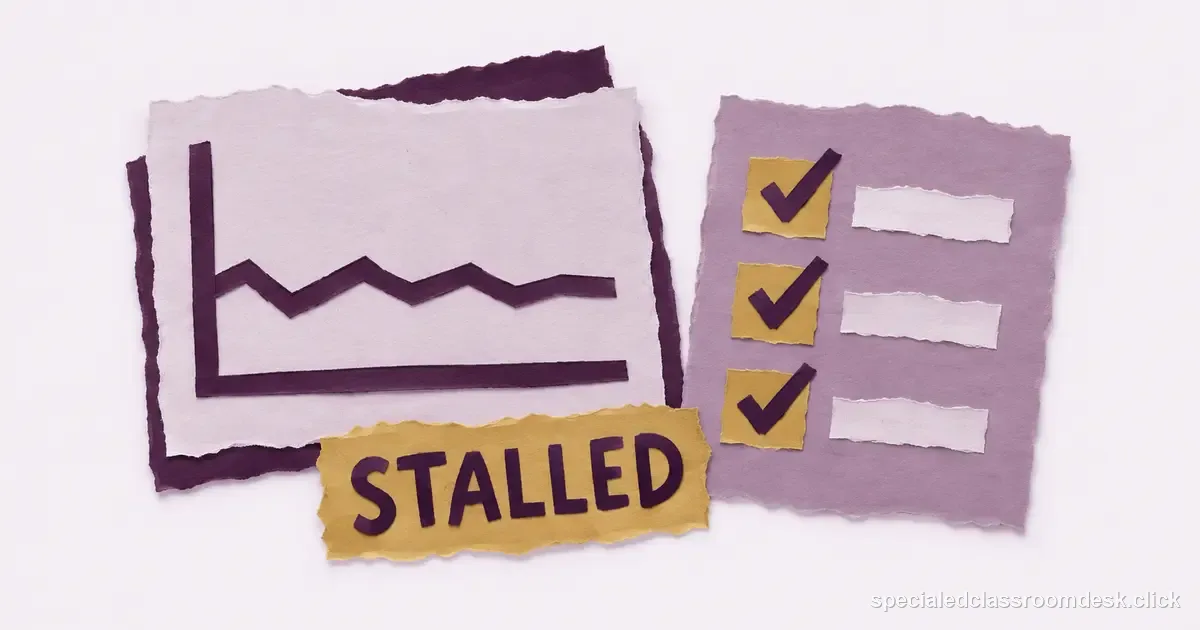
A flat or declining IEP goal should trigger a problem-solving sequence, not a last-minute sentence on the progress report. “Not making progress” can mean several different things: the measure is unstable, instruction has not been delivered as planned, the target is misaligned, the student needs a different intensity or approach, or new information suggests the IEP itself should be reviewed.
Confirm that the apparent stall is real
Place the baseline, goal line, and all comparable data points on one view. Check whether staff changed the probe, prompt level, passage difficulty, time limit, or scoring rule. A shift from a ten-item computation probe to a five-item quiz can create a jagged percentage series that looks like regression. Repair measurement inconsistency before drawing conclusions about learning.
Look at opportunity to learn
Review attendance and service delivery. If the student missed half the intervention sessions because of absences, assemblies, testing, transportation problems, or staffing gaps, the team needs that context. A goal cannot evaluate the effectiveness of instruction that did not occur. If scheduled services were not delivered, that is a separate implementation concern that should not be disguised as a student performance problem.

Open the errors, not just the graph
A flat total score can contain useful movement. A student may have mastered consonant blends while vowel-team errors persist, or stopped leaving class while the duration of remaining episodes stays long. Code the pattern. The next teaching adjustment should target the part of the skill that still breaks down.
Check whether the intervention matches the barrier
More minutes of the same mismatched instruction may not help. If the learner guesses unfamiliar words from context, additional silent reading time does not directly teach decoding. If writing breakdown occurs at planning, more copying practice does not address idea organization. Describe the instructional routine precisely enough to ask whether it targets the observed error.
Audit accommodations and access conditions
Sometimes the student appears to fail a goal because the support specified in the IEP is not consistently available. Check whether assistive technology works, visual supports travel with the student, testing accommodations are understood, and general-education staff know the implementation details. For goals that intentionally measure independent performance without a particular support, make sure staff are not accidentally changing the condition in the opposite direction.
Decide whether to intensify, revise, or ask the team to meet
Small instructional adjustments can occur within the existing IEP when they do not change the IEP's required content or services. But if the data suggest the annual goal, service amount, accommodation, behavior plan, placement, or another IEP component needs revision, involve the IEP Team rather than waiting for the next annual meeting. IDEA directs the team to revise the IEP as appropriate to address lack of expected progress; see 34 CFR §300.324(b)(1). Local procedures govern how meetings and amendments are handled.
Use a concrete six-week response plan
Example: Morgan's multiplication probe scores have remained between 30% and 40% for eight weeks. Error analysis shows frequent place-value alignment mistakes, and records show the planned small-group intervention occurred consistently. The teacher adds graph paper, explicit place-value modeling, and cumulative practice, while keeping the weekly probe condition unchanged. The team schedules a six-week review. If the trend remains flat despite faithful implementation, that stronger evidence supports a broader IEP discussion.
Do not lower the goal simply to make the graph look better
A target may need revision when new evaluation or progress information shows it is inappropriate, but changing a criterion only because the student is below it defeats the purpose of monitoring. Ask what new information justifies the change and whether services or instruction also need adjustment. The IEP is supposed to respond to need, not protect a mastery percentage.
Communicate before the surprise meeting
Families should not learn at the annual review that a goal has been flat for seven months. Use the reporting schedule in the IEP and communicate significant concerns according to school procedures. Share the actual measure, the pattern, what the team has tried, and the next decision point. Avoid jargon such as “insufficient ROI” without explaining what the student's scores are doing.
Escalate when the data reveal a new need
Unexpected loss of previously mastered skills, major behavior changes, or persistent failure across well-implemented supports may call for additional evaluation or reevaluation. IDEA permits reevaluation when educational or related-services needs warrant it or when a parent or teacher requests one, subject to the regulatory limits. Progress monitoring does not replace comprehensive evaluation when the question has become larger than one goal.
Decide whether the problem is access, instruction, or the goal itself
If the student cannot access the task under the conditions used for monitoring, fix the access problem first. If attendance, inconsistent service delivery, or a major schedule change reduced instruction, document that context. If instruction was delivered as planned but the trend remains flat, the team may need a different instructional approach. And if the goal measures a skill that no longer matches the student's priority need, revising the target may be more defensible than intensifying an irrelevant intervention.
Unexpected regression or persistent mismatch may warrant additional evaluation or reevaluation; one goal graph does not decide eligibility or placement.
Bring a compact evidence packet to the team
Assemble a one-page view separating scores from context: dates, measure, comparable task conditions, prompt level when relevant, instruction or services received, absences, and material classroom changes. Mark missing data instead of drawing a line across unobserved time. This helps distinguish a flat skill trend from an inconsistent measurement series.
Ask one neutral question for each possibility: Was the target explicitly taught? Were supports available? Does the probe sample the named skill? Is the goal still aligned with present levels? The team can decide whether to adjust instruction, improve implementation, collect better evidence, or revise the IEP. Do not promise an outcome or treat a classroom pattern as a legal determination.
Use a short review interval that fits the skill and the team’s decision, but do not present a particular number of weeks as a universal rule. Identify the next measure, who will collect it, and when the team will look at the series again. If safety, access, or educational need requires earlier action, follow district procedures rather than waiting for the next routine report. Keep the family informed through the designated communication channel and distinguish a proposed instructional adjustment from a formal IEP change.
Sources checked
Questions teachers ask
Do we have to wait until the annual IEP meeting to respond to poor progress?
No. Instruction can be adjusted as appropriate, and the IEP Team can meet or use permitted amendment procedures when an IEP component may need revision. Follow local procedures.
Should the goal be lowered if the student is far behind the target?
Not merely to produce a passing result. Revise a goal when new information supports a different appropriate target, and examine whether instruction, services, or supports also need change.
What if services were frequently missed?
Document the missed opportunities and address implementation separately. It is difficult to judge an intervention from a period in which the planned service was not consistently delivered.
Can poor progress trigger reevaluation?
It can contribute to the need for reevaluation. IDEA provides for reevaluation when educational or related-services needs warrant it or when a parent or teacher requests one, subject to applicable limits.