Accommodations vs. Modifications in an IEP: The Difference That Changes What the Student Is Asked to Learn
Distinguish accommodations from modifications by whether access changes or the learning expectation changes, with classroom examples and IEP cautions.

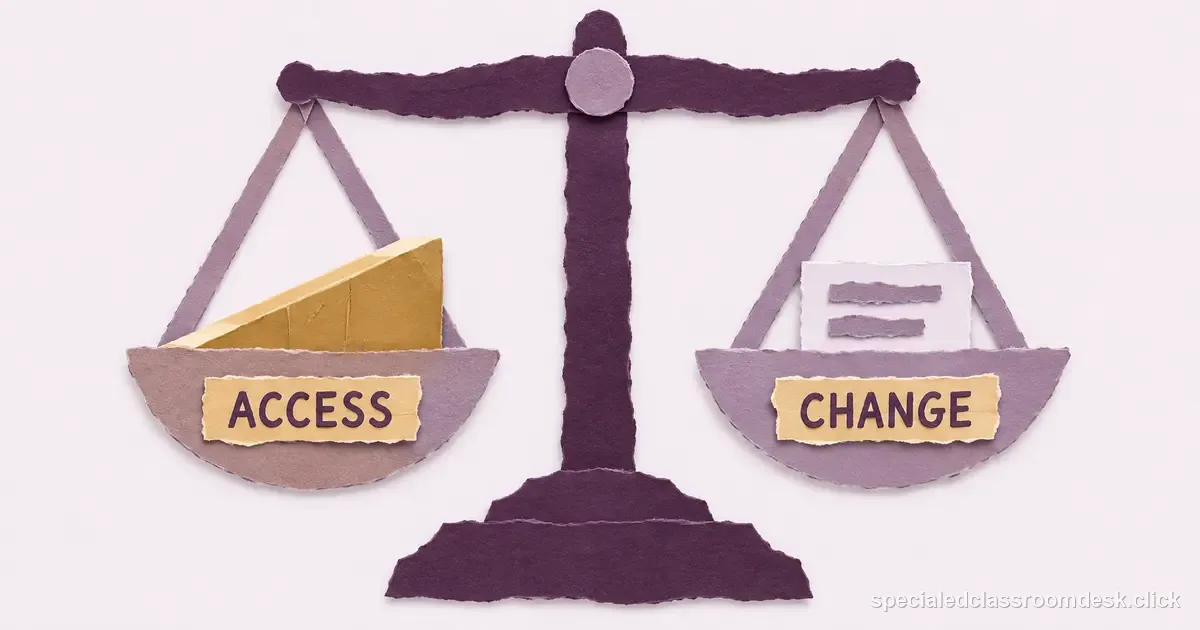
The cleanest distinction is not “small support versus big support.” An accommodation changes how a student accesses instruction or demonstrates learning without changing the intended learning expectation. A modification changes what the student is expected to learn or the level of the academic expectation. That distinction matters for instruction, grading, assessment, and communication across classrooms.
Test the expectation, not the appearance of the support
Extra time can be an accommodation because the student still completes the same intended task with more time. A shortened assignment can be either: reducing 30 repetitive practice problems to 15 while preserving the same skill may be an accommodation or workload support, while replacing grade-level fraction problems with single-digit addition changes the content expectation and is a modification.
Reading access shows the difference clearly
If the learning target is understanding grade-level science concepts, text-to-speech may allow a student with a reading disability to access the same science content; that is commonly an accommodation when appropriate. If the student instead receives substantially simpler science content with different learning targets, the expectation has changed. The label follows the instructional effect, not the technology.

Writing supports can preserve the target
Speech-to-text, word prediction, a keyboard, extended time, or a graphic organizer may allow the learner to demonstrate ideas without the disability-related barrier dominating the task. But if an assignment expected a multi-paragraph argument and the student's requirement is changed to identifying one picture, the academic expectation has been modified.
Why the distinction matters to general-education teachers
A teacher implementing an accommodation still needs to evaluate the intended grade-level learning unless the IEP says otherwise. A modification may require different instructional materials, success criteria, or grading interpretation. If staff receive a list that simply says “modified work as needed,” they are forced to guess what content can change. The IEP Team should make the implementation specific enough to be usable.
Do not infer a modification from disability category
Students with the same eligibility category can need very different supports. One student may use only accommodations; another may require modifications in a particular subject; another may have different needs across settings. The IEP is individualized. Category, placement, or classroom label does not automatically determine the type of support.
Assessment rules require a separate check
Classroom accommodations do not automatically transfer to every state or districtwide assessment. IDEA requires the IEP to identify individual appropriate accommodations necessary for those assessments, and state assessment policies control what is permitted. Teachers should verify the assessment-specific plan rather than assuming any everyday support is allowed in the same form.
Four examples to classify by the learning target
Audio directions: accommodation when the student is still solving the same math problems. Fewer practice items: may preserve the target if the reduced set samples the same skill. Alternate vocabulary list: may be a modification if it lowers or changes the expected content. Calculator: accommodation when calculation is not the construct being assessed, but potentially inappropriate when independent calculation itself is the target.
| Access accommodation | Modified learning expectation | |
|---|---|---|
| What changes | How the student accesses or demonstrates the same target | What the student is expected to learn or demonstrate |
| Example from the article | Text-to-speech for the same grade-level science concepts | Different, simpler science content with different targets |
| Decision clue | Support addresses the disability barrier | The assessed academic expectation changes |
Use a target check for borderline cases
| Change being considered | Likely accommodation when… | Likely modification when… |
|---|---|---|
| Text-to-speech or read-aloud | The task measures science knowledge and the same science content is assessed. | Independent decoding or reading comprehension is the skill being measured and the support supplies that skill. |
| Fewer questions | The shorter set still samples the full target skill adequately and the criterion is unchanged. | Omitted items remove required content or lower the expected breadth or mastery level. |
| Calculator | The target is problem solving and computation is not what the item is intended to assess. | The target is independent calculation and the calculator performs that skill for the student. |
| Speech-to-text | The target is idea development or content knowledge and handwriting/typing is not being measured. | The task specifically measures independent transcription or written mechanics supplied by the tool. |
These are decision examples, not automatic labels. State assessment rules and the exact learning target matter. Missouri DESE’s guidance makes the same target-dependent point with the reduced-math-items example; use it as one state illustration, not a nationwide rule. Missouri DESE guidance.
Write enough detail to prevent classroom improvisation
“Preferential seating” can mean six different things. Specify the functional purpose and implementation when needed: seat with a clear view of visual instruction, away from a known distraction, or near an outlet for assistive technology. “Reduced workload” should identify how staff choose essential items. Precision reduces inconsistent implementation without turning the IEP into a minute-by-minute lesson plan.
Check the student's actual experience
An accommodation that exists only on paper is not access. Ask whether the student knows how and when to use the support, whether materials arrive in time, whether technology is charged, and whether adults inadvertently make the support stigmatizing. Implementation data can be as practical as noting whether the student used text-to-speech on assigned reading and whether it improved access to the content.
A shortened assignment may preserve the same skill or may change the target. Classify it by what the student is asked to learn, not by its name.
Bring unclear cases back to the team
Teachers should not independently lower expectations because an accommodation seems insufficient. If a student cannot access the learning target with the current supports, document the problem and bring evidence to the IEP Team. The question may involve additional accommodation, specialized instruction, assistive technology, evaluation, or a modification decided through the IEP process.
Use a grading example to expose the distinction
Consider a science unit on ecosystems. Giving a student text-to-speech, extended time, or a reduced-distraction setting may change access while preserving the same ecosystem concepts and assessment target. Replacing the assignment with identification of three animal pictures when classmates are analyzing energy flow changes what the student is expected to demonstrate; that is a modification of the learning expectation. The label should follow the actual change, not the teacher's intention.
When grading or diploma implications are possible, follow state and district guidance and make sure the IEP team understands the consequence before the modification is implemented.
When in doubt, ask whether the student is still being evaluated on the same essential learning target as peers. That question often exposes whether the change is access support or a change in expected learning.
Sources checked
Questions teachers ask
Is extra time an accommodation or a modification?
Extra time is typically an accommodation when it changes access or response time without changing the learning expectation.
Is a shortened assignment always a modification?
No. Reducing repetitive items can preserve the same target. It becomes a modification when the change alters what the student is expected to learn or demonstrate.
Can a teacher decide to modify an assignment without the IEP Team?
Teachers can differentiate instruction, but they should not independently replace the IEP-defined learning expectations or supports. Bring persistent access problems to the team and follow district procedures.
Are classroom accommodations automatically allowed on state tests?
No. Assessment accommodations are governed by the IEP and applicable state or districtwide assessment policies. Verify the assessment-specific requirements.