Self-Regulation IEP Goal Example: Measure Recognition, Strategy Use, and Return to Learning
Turn self-regulation into observable data by defining triggers, taught strategies, prompt levels, duration, and a realistic return-to-learning outcome.

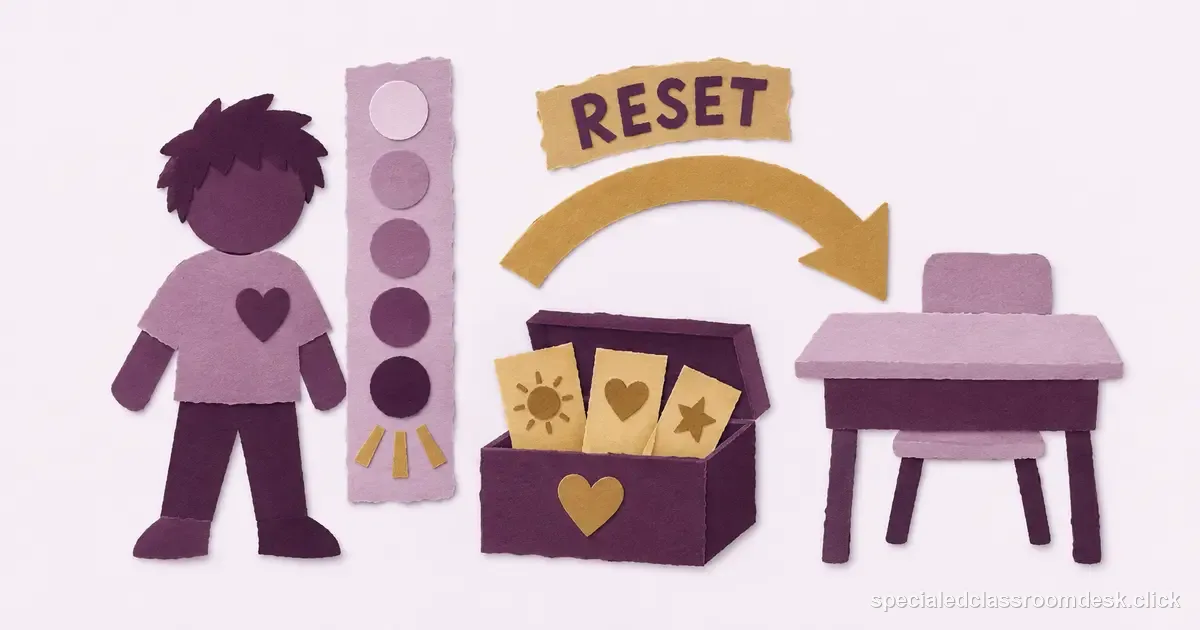
Self-regulation is internal, so the IEP goal has to measure behaviors that can be observed without pretending staff can read a student's emotional state. Instead of “will be calm,” identify the sequence the student is learning: notice a signal, communicate a need, use a strategy, and return to or appropriately change the task.
Describe the escalation pattern before choosing a strategy
Review several real episodes. For Devon, the first observable signals might be pushing materials away, repeating “I can't,” and putting his head down after an unexpected correction. Escalation may occur if an adult immediately repeats the demand. Recovery may happen after five minutes in a quiet space. Those details are more useful than a label such as “meltdown,” because they identify points where instruction and environmental support can work.
Collect baseline information on frequency, duration, context, and current supports. If Devon already independently asks for a break in 6 of 10 difficult math tasks, a goal requiring a break request in 4 of 5 opportunities would not represent meaningful growth.
Choose a strategy the student can actually access while stressed
A five-step coping chart may be impossible to use at the peak of escalation. Rehearse a small menu during regulated moments: show a break card, request help, use headphones where permitted, move to a designated seat, use a brief breathing routine, or ask to split the task. The choice should fit the student's communication, sensory, and safety needs.

Measure the sequence, not a vague mood
One data sheet can include four fields: trigger or task condition; signal observed; strategy used and prompt level; time until return or next appropriate activity. This distinguishes a student who independently requests a three-minute break and returns from a student who leaves the room for 25 minutes after repeated adult prompting.
A goal with a meaningful endpoint
The endpoint is not “be calm.” It is using a response and re-engaging with an agreed next step. In some situations that next step may be returning to the original task; in others it may be a modified chunk, a supported start, or another plan established by the team.
- Early signalIdentify the documented trigger or observable stress signal.
- Communicate a needUse a taught request for help, a break, or an agreed work option.
- Use the strategyRecord the strategy and prompt level.
- Agree on the next stepNote return to the task or another team-agreed activity.
- Review the patternLook at duration, support, and environmental conditions as well as frequency.
Do not turn regulation into forced endurance
If data repeatedly show that a specific environment, workload, sensory condition, or interaction triggers distress, the team's job is not only to make the student tolerate it longer. Examine accommodations, task design, communication supports, and whether the behavior indicates a need for functional assessment. Regulation instruction and environmental change often belong together.
Track latency and duration carefully
Frequency alone can mislead. Three brief break requests may be healthier than one two-hour shutdown. Duration can also improve before frequency changes. If episodes remain weekly but average recovery time falls from 30 minutes to 8, that is important progress. Use the dimension that matches the problem described in present levels.
Plan how adults will respond to the strategy
A student will stop requesting a break if adults routinely deny it or argue about whether the student “really needs” one. Define what happens after the request: where the break occurs, typical length, how return is signaled, and what safety boundaries apply. Staff consistency is part of teaching the replacement behavior.
Because regulation is partly internal, invite the student to note whether the chosen strategy felt useful and whether the next step was manageable. Keep that brief student report beside—not in place of—the observable record of prompt level, break duration, and return to learning. A mismatch between the student's report and adult observation is a reason to discuss conditions, not to assume either account is invalid.
Distinguish self-advocacy from escape
Adults sometimes worry that a break request lets a student avoid work. The data can answer that concern. Track whether the student returns, what portion of the task is completed afterward, and whether the task itself needs adjustment. A functional break can increase completed work by preventing a much longer escalation.
Review the goal when the strategy becomes routine
Once Devon independently uses a break or help request, the next need may be identifying earlier cues, choosing among strategies, tolerating small changes with preparation, or self-monitoring across settings. Do not keep an easy regulation goal for the rest of the year merely because the data look good. Successful progress monitoring should tell the team when a target is ready to evolve.
Score adult prompting separately from strategy success
If a student eventually uses the break routine after three direct prompts, that is different from independently noticing an early cue and requesting the break. A simple prompt code—independent, indirect cue, direct verbal prompt, model, physical guidance where appropriate—can show progress that a yes/no “used strategy” box misses. The prompt data may improve before episode frequency changes.
When the student begins using the strategy independently, check whether adults are still honoring it consistently. A regulation plan can fail because the environment stops responding to the communication, not because the student forgot the skill.
When a pattern points to an inaccessible task, sensory condition, or interaction, examine accommodations and task design along with strategy instruction.
Plan for co-regulation and student choice
Instruction may begin with an adult helping the student notice a cue, name a need, and choose a supported strategy. Record who initiated it, what support was offered, whether the student selected or declined it, and how access to instruction resumed. A prompt code should describe assistance, not imply that accepting a break is better than requesting another support.
Agree how staff will honor the student’s communication. If the student asks for space or uses AAC to request a break, document whether the response was available and how the re-entry routine worked. Regulation should not become forced endurance or require suppressing distress for a score. Note changes in noise, task length, staffing, or schedule and review patterns before concluding that a skill has been lost.
Sources checked
- IDEA §300.320 — Functional annual goals and supports
- U.S. Department of Education — Functional Behavioral Assessment guidance
- IEP Progress — How to Write IEP Goals for Self-Regulation
- The IEP & 504 Library — IEP Behavior and Self-Regulation Goals
- Utah State Board of Education — IEP Reflective Framework: Goals
Questions teachers ask
Can “remain calm” be a measurable IEP goal?
It is usually too subjective. Define observable actions such as requesting a break, using a taught strategy, reducing episode duration, or returning to an agreed task step.
Should break requests count as avoidance?
Not automatically. A taught break can be a functional regulation and communication strategy. Track return to activity and examine whether the task or environment also needs change.
What if adults use different regulation routines?
That inconsistency can undermine the skill. The team should define how the student's communication is honored, what the strategy looks like, and how return or re-entry is supported.
Do I need frequency data for every self-regulation goal?
No. Duration, latency, prompt level, strategy use, or successful re-entry may be more relevant. Pick the dimension that matches the student's identified need.