IEP Progress Report When There Is Not Enough Data: What to Say and What to Do Next
Write an honest IEP progress report when a new goal, missed probes, or limited opportunities leave too little evidence for a confident trend.


A progress report can be due even when the evidence is thin. A new goal may have only one probe, a student may have been absent, a measure may have changed, or the skill may occur in too few natural opportunities to show a stable pattern. The report still needs to tell the reader what was measured, what the available evidence shows, and what it cannot support yet. “Insufficient data” is a useful status only when it is accompanied by a clear explanation and a next step.
First decide whether the evidence is limited or the skill is not progressing
These are different conclusions. “No progress” means usable observations show little or no change under comparable conditions. “Insufficient data” means the team does not have enough valid, representative observations to judge the direction or rate of change. A blank field, a missed assessment, and a low score are not interchangeable. Preserve the difference in both the data record and family-facing explanation.
Start by reviewing the goal’s measurement statement: what counts as an opportunity, what response is scored, what supports are allowed, how often samples are planned, and what criterion defines progress or mastery. Then list the actual observations by date. Mark the measure used, context, number of opportunities, and any reason the sample was not completed. This simple inventory often reveals whether the barrier is a short collection window, inconsistent implementation, a poorly defined measure, or a genuine lack of expected progress.
IDEA requires the IEP to describe how progress toward annual goals will be measured and when periodic progress reports will be provided. Federal rules do not supply a universal number of probes that makes a report “enough.” Follow the individual IEP, state rules, district reporting procedure, and the characteristics of the measure. Do not present a local rule of thumb as a national requirement.
Audit the sample before writing the conclusion
Use a short evidence audit. How many planned observations occurred? Are they spread across enough time to show a pattern? Did the student have a genuine chance to demonstrate the skill? Were the same task, prompt level, setting, scoring rules, and assistive supports used? Did the scorer record raw results or only an impression? A report based on one unusually easy worksheet or one unusually difficult day may be accurate about that event but weak evidence of an annual trend.
For an academic goal, three scores may be more interpretable than one, but three is not a universal threshold. For a functional skill that occurs naturally, a team might need samples from multiple settings or different types of opportunity. For a rate measure, comparable alternate forms and a consistent timing rule matter. If the goal specifies a particular measure, do not quietly substitute a different test because it is convenient; bring a mismatch to the case manager or team.
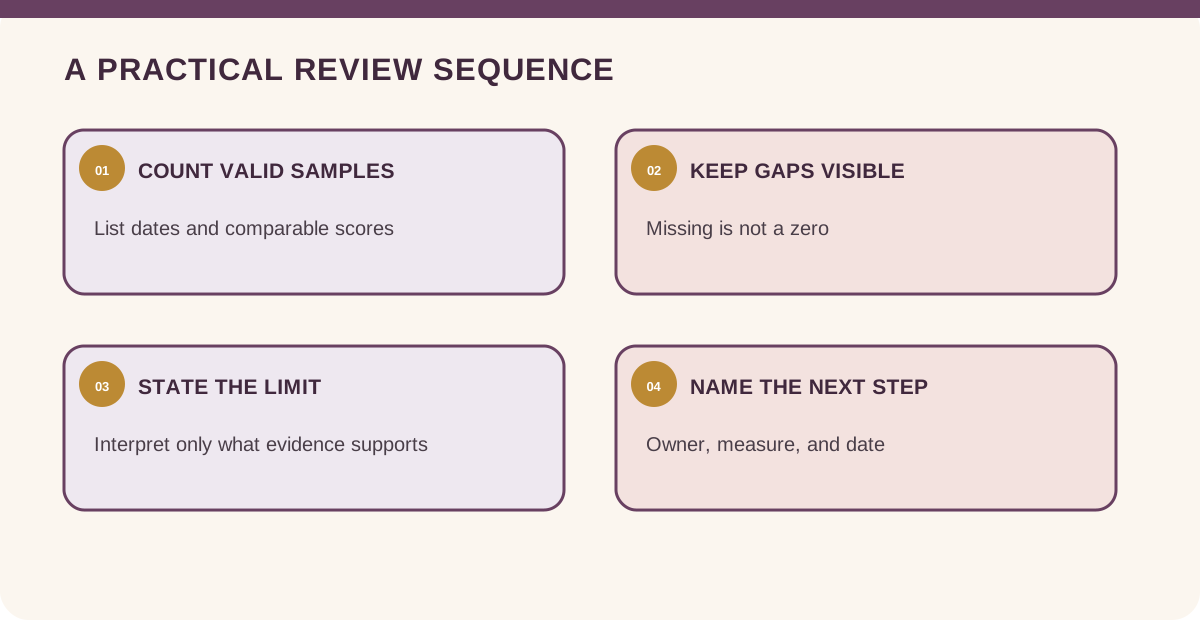
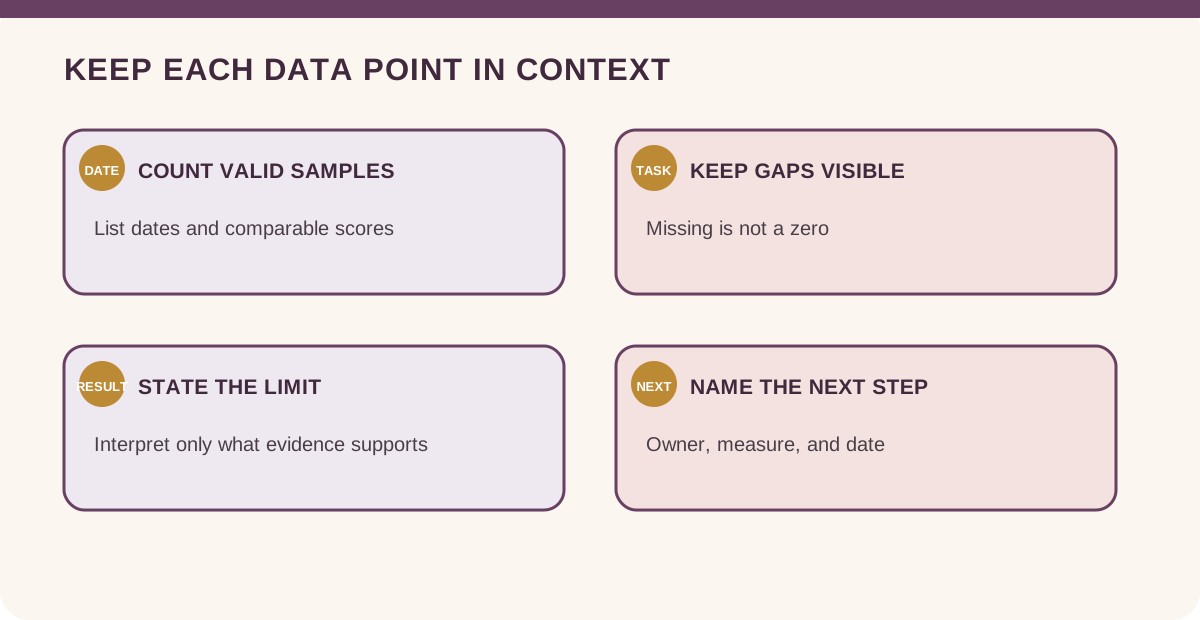
Keep missing observations visible. If a student was absent, mark “not administered—absent,” rather than entering zero. If the probe was missed because materials were unavailable, record that factual reason. If a student was present but no opportunity occurred, distinguish “no opportunity” from “did not demonstrate.” Avoid filling gaps by estimating scores from memory, converting classroom impressions into precise percentages, or drawing a straight line through unobserved weeks.
- MeasureUse the method stated in the IEP.
- SampleList valid observations and dates.
- LimitName gaps and non-comparable conditions.
- Next stepAssign the next collection date and owner.

Use report language that states evidence and limits
A useful report has four parts: the measure or observation window; the number and range of valid samples; the interpretation supported by those samples; and the next data-collection step. Use direct language. Avoid a vague “making progress” when no data are summarized, and avoid an overly precise average that hides a tiny sample. If the district’s reporting form has fixed status labels, pair the label with a short narrative when the label alone could be misunderstood.
| What the record shows | Careful report wording | What to avoid |
|---|---|---|
| One comparable sample after a goal was added recently | “One probe was collected since the goal began; it is an initial point and is not enough to describe a trend.” | “The student is on track” based on one score |
| Planned probes missed because of absence | “Two of four planned probes were completed. The other dates are marked not administered due to absence, not scored as zero.” | Entering zero or implying the student failed the probe |
| Scores vary and conditions changed | “Results ranged from 5 to 9 correct; the task format differed, so the scores are not treated as a comparable series.” | Calling the swing regression or growth without checking form difficulty |
| Few opportunities for a naturally occurring skill | “Two relevant opportunities occurred during this window. The next review will summarize additional observations across settings.” | Inventing opportunities or treating no opportunity as an unsuccessful response |
Examples should be rewritten with the student’s actual evidence and the district’s language. Keep the report understandable to caregivers who may not know terms like “probe,” “alternate form,” or “curriculum-based measure.” A concise explanation such as “we have not yet observed this skill often enough to tell whether the pattern is changing” is more useful than unexplained technical shorthand.
Separate a data gap from an instruction or access gap
Limited measurement can happen for several reasons. The goal may be new. The monitoring schedule may be too infrequent for the reporting window. Absences or school closures may have removed opportunities. Staff may not agree on what counts. A measure may be difficult to administer with a required accommodation. A service schedule or staffing disruption may have reduced instructional time. These possibilities require different responses, so identify what is known before assigning a cause.
Compare the measurement calendar with service and instruction records, while keeping each record’s purpose clear. A progress probe shows performance on a defined task; a service log shows what was delivered; an attendance record shows presence; a work sample shows performance in a particular assignment. No one source alone answers every question. If a pattern of missed data lines up with a pattern of missed instructional access, document both and raise the concern through school procedures rather than compressing them into “not enough data.”
Do not claim that a missed accommodation caused a low score unless the evidence supports that conclusion. Do not decide that services are owed, that a compensatory remedy applies, or that the IEP must be changed based solely on a short progress report. Those are individualized questions for the responsible school team and applicable state or district process. The report can identify a concern and the facts that need review without deciding the outcome.
Choose a practical next collection plan
Make the next step specific enough to happen. Name the measure, approximate timing or frequency, person responsible, and how the result will be shared or reviewed. If the original cadence remains appropriate, resume it with comparable conditions. If no realistic opportunity is expected before the next reporting date, tell the case manager now rather than waiting for a blank report. Any change to the IEP’s measurement or reporting terms must follow the district’s IEP process.
For example, a team might record that two out of five planned weekly probes were completed, keep the three missing dates as missing, and schedule the next three comparable probes on the regular weekly day. If the goal is a communication skill, the team might agree to record the next naturally occurring opportunities during two routines instead of asking staff to stage artificial situations. A next-step plan should improve the evidence without changing what the goal means.
Use an owner and a review date. “Continue to monitor” is too open-ended when nobody knows who will collect the next sample. A better note states: “The reading specialist will administer the same one-minute passage probe weekly for the next three weeks, note the passage set and accuracy, and send the dated scores to the case manager before the next progress update.” Adjust this example to the actual instrument and district workflow.
When limited data should prompt a team conversation
Bring the issue to the case manager or IEP team when the current data plan repeatedly fails to produce interpretable evidence, when expected progress is not occurring in the available comparable samples, when the student’s needs or circumstances have changed, or when families or staff raise information that the report does not capture. IDEA’s review-and-revision rule requires periodic review at least annually and revisions as appropriate; that does not mean every sparse report automatically requires an immediate full meeting. Follow local procedures for reconvening or making agreed amendments.
Prepare a one-page evidence packet: the goal’s exact measure, planned and completed dates, valid scores, missing-data reasons, relevant changes in conditions, and a question for the team. Examples of useful questions include: “Does this measure give us enough opportunities to judge the skill?” “Are the samples comparable?” “Do we need a more workable data-collection routine?” and “What additional information should we consider before interpreting progress?” This keeps the discussion focused on a decision rather than blame.
Protect privacy while sharing records. Store student-level data in district-approved systems and share it only with staff who have a legitimate educational need. Public examples, training materials, or personal spreadsheets should never contain identifiable student details. Use a fictional example or approved de-identified data when teaching the reporting process.
| Record type | No valid observation | Observed performance |
|---|---|---|
| Example | Probe not administered; reason noted | Score recorded under defined conditions |
| Meaning | No conclusion about skill from that date | Evidence may be compared with similar samples |
| Follow-up | Schedule the next appropriate sample | Interpret with the goal's measurement rule |
A concise checklist before sending the report
- Did I use the measure and conditions in the current IEP?
- Did I state how many valid observations were available and the dates they cover?
- Did I distinguish a low score from a missing score or missing opportunity?
- Does my conclusion match the amount and comparability of the evidence?
- Have I named a concrete next step and responsible person where evidence is still limited?
- Have I followed the district’s reporting, communication, and confidentiality rules?
The point is not to make every report look certain. It is to make the record trustworthy. A transparent statement of what is known, what is missing, and what happens next gives families and staff a better basis for deciding whether the plan is working.
Sources checked
Questions teachers ask
What should an IEP progress report say when there is not enough data?
State the measure and dates, how many valid samples were collected, why key observations are missing or not comparable, what conclusion the evidence can support, and the next specific collection step.
Is one probe enough to say an IEP goal is on track?
Usually one point is only an initial observation, not a stable trend. Follow the goal, instrument, district reporting rules, and the team’s agreed interpretation method.
Should an absence be reported as zero progress?
No. An absence or unadministered probe is missing data, not a performance score. Record the approved status and keep it separate from the score series.
Does insufficient data automatically require an IEP meeting?
No single federal rule says every sparse report triggers an immediate meeting. Raise recurring measurement problems or concerns through district procedures; IDEA requires periodic review at least annually and revision as appropriate.