Functional Behavioral Assessment Basics: Move From “What Happened?” to “What Is the Behavior Doing?”
Use FBA basics to define behavior, collect ABC and contextual data, test a function hypothesis, and connect findings to prevention and replacement skills.

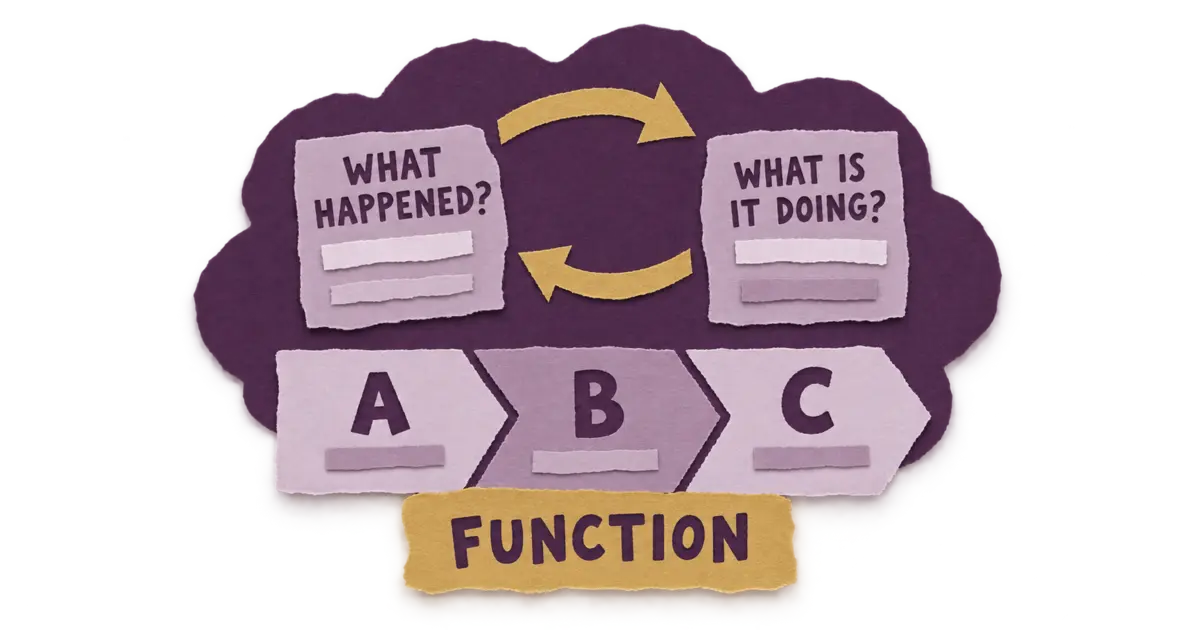
A functional behavioral assessment is a process for understanding why a behavior occurs so support can address its function rather than merely suppress its appearance. U.S. Department of Education guidance emphasizes function-based thinking as a way to create supportive learning environments. An FBA is not simply a behavior tally, and “the student wants attention” is not a function hypothesis unless data support it.
Define the behavior so observers can agree
Replace “aggressive” with the action being measured: “hits, kicks, or pushes another person with enough force to move the person or produce an audible impact.” Replace “off task” with a definition tied to the task. Include examples and nonexamples when staff disagree. A behavior definition is useful when two adults observing the same event would count roughly the same occurrence.
Collect antecedent-behavior-consequence data without assuming causation
ABC notes capture what happened immediately before, the observable behavior, and what followed. Example: antecedent—teacher presents an independent writing task after lunch; behavior—student tears worksheet and places head on desk; consequence—task is removed for ten minutes and adult talks one-to-one. One event does not prove function, but repeated patterns can reveal conditions associated with behavior.

Combine three kinds of evidence
| Evidence stream | Useful examples | What it can answer | Check before concluding |
|---|---|---|---|
| Existing records and indirect input | Prior plans and incidents, attendance, teacher/family/student interviews, work samples | Where to observe; what changed; when the behavior is absent; what the student or adults notice | Interview accounts generate leads, but recall or expectations alone do not establish function. |
| Direct observation | Operationally defined ABC events, frequency/duration/latency, time, setting, people present, task and support conditions | Whether a pattern repeats before and after the behavior, including contrasting periods when it does not occur | Use the same definition and comparable observation windows; note missing or unusual context. |
| Context and response review | Task difficulty, communication access, environmental conditions, adult/peer response, prior support results | Whether a competing explanation or access barrier fits better than the first function guess | Consider cultural and linguistic context and avoid inferring intent from disability, diagnosis, or a single event. |
The U.S. Department of Education describes FBA as individualized and built from direct, indirect, and existing information. The goal is to understand patterns of occurrence and nonoccurrence, not to collect the same ABC form indefinitely.
Look beyond the immediate trigger
Setting events and broader context can matter: sleep disruption reported by family, schedule changes, medication changes when appropriately shared, a substitute teacher, missed breakfast, noisy assemblies, or a difficult peer interaction earlier in the day. Teams should handle private health and family information carefully while recognizing that behavior does not occur in a vacuum.
Possible functions are hypotheses, not labels
Behavior may help a student access attention, a tangible item or activity, sensory stimulation, or escape/avoidance of a demand, among other functional descriptions depending on the assessment framework. The same visible behavior can serve different functions for different students, or multiple functions for one student. Data must drive the hypothesis.
- Define the behaviorUse actions that observers can count consistently.
- Record the sequenceCapture what happened before, the behavior, and what followed.
- Check broader contextReview setting events and conditions with appropriate privacy.
- Test the function hypothesisCompare patterns where the behavior occurs and where it does not.
- Plan prevention and replacementAdjust predictable triggers and teach a response that meets the same need.
- Monitor both outcomesTrack the target behavior and the replacement skill.
Test the hypothesis against patterns
Suppose task-tearing occurs primarily during extended handwriting, rarely during oral discussion, and is usually followed by work removal. Work samples show the student can explain answers orally but writes slowly and reports hand fatigue. A plausible hypothesis is that tearing produces escape from a high-effort writing demand. That hypothesis points toward different support than an assumption that the behavior is maintained by adult attention.
Measure frequency, duration, latency, or intensity as appropriate
Pick dimensions that match the behavior. A 40-minute shutdown once a week may be more important to capture by duration than by frequency. For task initiation, latency from direction to first action can show improvement. Intensity scales require clear anchors; “mild/moderate/severe” is unreliable unless each level is behaviorally defined.
Ask what skill could meet the same need more safely or efficiently
If the function is escape from an overwhelming writing demand, a replacement response might be requesting a short break, asking to dictate the first sentence, or using an agreed help signal. The support plan should also examine task difficulty and access accommodations. Teaching “sit quietly” does not provide a functional alternative to escape.
Prevention is part of function-based support
Change predictable antecedents where possible: adjust task chunking, clarify visual expectations, build choice, schedule supports before known difficult periods, or ensure communication tools are available. Prevention is not “giving in.” It can remove unnecessary triggers while the student learns the replacement behavior.
Know when the process belongs with the IEP Team
Behavior assessment can have legal and procedural implications, particularly for students with disabilities and disciplinary situations. Follow IDEA, state rules, and district procedures for when an FBA is conducted, who participates, consent or notice requirements where applicable, and how findings are incorporated into the IEP or behavior plan. Classroom data can inform the process, but teachers should not create a quasi-clinical FBA outside required procedures and present it as official.
Do not treat every suspension as an automatic FBA trigger
IDEA's discipline rule is more specific. When a disciplinary decision changes the student's placement, the required manifestation determination is due within 10 school days. If the team determines that the conduct was a manifestation of the student's disability, the IEP Team must conduct an FBA unless the agency already conducted one before the behavior at issue and implement a BIP; if a BIP already exists, the team reviews and modifies it as necessary. Other situations may trigger assessment or support duties under the student's IEP, FAPE obligations, state law, or district procedures, so route a discipline question to the administrator handling safeguards.
ABC notes are one source. Combine observations with other information and follow district procedures for an official FBA.
Judge the FBA by the plan it makes possible
The final question is whether the hypothesis leads to support that can be tested. A strong FBA makes the next steps specific: prevent the triggering condition where appropriate, teach a functionally equivalent response, change adult consequences so the replacement works, and monitor both the target behavior and the new skill.
Test the hypothesis against events that do not produce the behavior
If disruption is believed to escape difficult writing, compare writing periods in which the behavior occurs with equally difficult tasks where it does not. Perhaps adult proximity, task length, peer attention, or the way directions are delivered differs. A good functional hypothesis should explain both occurrence and nonoccurrence reasonably well. If it predicts every behavior in every setting, it is too broad to guide intervention.
Use direct observations alongside interviews and record review; staff recollection alone can overrepresent the most memorable episodes.
Record the consequence immediately after the behavior as carefully as the antecedent. Adult attention, peer reaction, task removal, delay, sensory change, or access to an item can each strengthen a different hypothesis.
Sources checked
- U.S. Department of Education — Using Functional Behavioral Assessments to Create Supportive Learning Environments
- IDEA §300.530 — Discipline and manifestation determinations
- IDEA §300.320 — IEP supports and functional goals
- Center for Parent Information and Resources — Functional Behavior Assessment Brief
Questions teachers ask
Is ABC data the same thing as a complete FBA?
No. ABC observation is one possible data source. A complete FBA integrates direct observation, indirect input, existing information, context, and a supported hypothesis about behavior function.
Can the same behavior have different functions?
Yes. A visible behavior can serve different functions across students or contexts, which is why support should be based on individualized assessment rather than the behavior's appearance.
Does every suspension require an FBA?
No. IDEA has a specific FBA/BIP requirement when a disciplinary change of placement is followed by a manifestation determination finding that the conduct was a manifestation. State, district, IEP, and FAPE requirements may also matter; consult the staff member responsible for the process.
What makes a replacement behavior “functionally equivalent”?
It gives the student an appropriate way to obtain the same outcome the problem behavior was producing, such as requesting help or a break instead of escaping through disruption.