How Often Should You Progress Monitor an IEP Goal?
Choose an IEP progress-monitoring frequency based on skill sensitivity, opportunity rate, intervention intensity, decision deadlines, and staff burden.
There is no federal rule that says every IEP goal must be progress monitored weekly. IDEA requires the IEP to describe how progress will be measured and when periodic progress reports will be provided. The useful frequency depends on how quickly the skill can change, how often the behavior occurs, how intensive the instruction is, and how soon the team needs enough data to make a decision.
Think in decision windows, not calendar habits
Ask when you would realistically change instruction if progress were weak. If a student receives daily intensive decoding instruction, collecting one data point each quarter would make it impossible to detect a poor response early. A brief weekly probe may fit. If a goal is a multi-paragraph research response that requires several lessons to produce, weekly full essays may create noise and consume instruction; a monthly comparable product plus shorter component checks can be more useful.
Academic probes can often tolerate higher frequency
Brief curriculum-based measures are designed for repeated sampling. A one-minute oral-reading probe or short computation probe can provide enough observations to estimate trend without sacrificing a full class period. Weekly or every-other-week collection may make sense when the team expects measurable growth and is prepared to respond to the trend. The exact cadence is a team and local implementation decision, not a universal legal number.
Natural-opportunity goals need a different clock
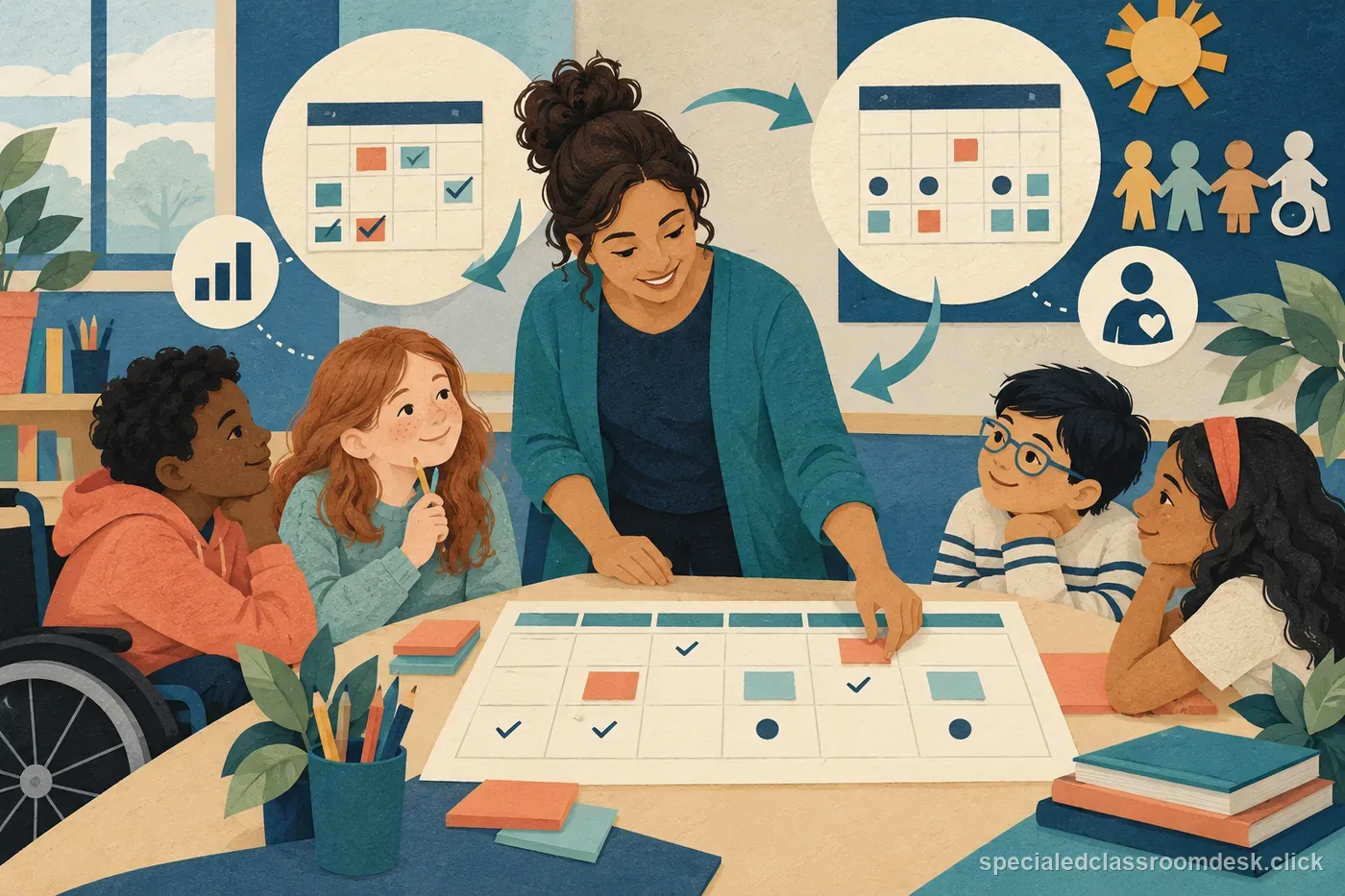
A peer-conflict response may occur unpredictably. “Collect every Tuesday” could produce zero opportunities one week and several the next. Define a data window instead: tally the first five qualifying opportunities each week, or summarize all naturally occurring events across five school days. For low-frequency behavior, duration or time-between-events may be more informative than a percentage.
Complex products need enough time to develop
Writing, project planning, transition activities, and some functional routines may be sampled less often because each data point represents a substantial performance. Do not solve the low-frequency problem by inventing tiny artificial tasks that no longer resemble the goal. Instead, collect component data during instruction and schedule authentic goal-level samples often enough to judge direction.
Build around instructional change points
If an intervention cycle is six weeks, you need enough data within those six weeks to distinguish a trend from random fluctuation. With one point at the beginning and one at the end, you cannot see whether growth was steady, late, or nonexistent. With repeated comparable points, you can ask whether the student is responding before the cycle ends.
More data are not automatically better data
Daily measurement can create practice effects, staff fatigue, and rushed scoring. It can also turn a goal into constant testing. If daily scores are highly variable and no one reviews them until the quarter ends, the frequency is not serving a decision. Reduce burden or summarize repeated observations in a way the team can actually use.
Separate collection from reporting
A teacher may collect weekly data and report progress to parents on the schedule specified by the IEP, such as with regular report periods. Those are different functions. Collection frequency should be sensitive enough for instructional decisions; reporting frequency tells families when formal updates will be provided. Avoid interpreting a quarterly report schedule as permission to collect only four data points per year when the goal needs closer monitoring.
Create a missed-data rule before busy weeks arrive
Testing windows, absences, assemblies, staff coverage, and holidays will interrupt even a good plan. Decide what counts as a valid make-up and when a week should be marked “no data” rather than filled with a noncomparable task. Do not backfill missing points from grades or informal impressions just to make the graph look complete.
Write down who collects what and what happens when a point is missed
A frequency such as “weekly” is not an executable plan by itself. Use a short schedule that names the measure, collector, setting or opportunity window, backup rule, and review date. This example is a planning aid; follow the individualized IEP and district procedure when they specify the method or schedule.
| Goal sample | Collector and setting | Cadence | If the sample is missed | Review point |
|---|---|---|---|---|
| Decoding probe | Reading specialist; same quiet instructional block | One equivalent form each Friday | Use the next comparable school day; mark no data if the window closes | Check the six-week trend with the intervention record |
| Peer-response opportunity | Trained classroom staff; qualifying peer-work events | First three valid opportunities across three days | Record “no opportunity” when none occurs; do not score it as success or failure | Review after the planned opportunity window |
| Extended writing sample | Case manager; comparable writing task and rubric | One completed sample every four weeks | Reschedule within the same instructional cycle or note the reason no sample exists | Compare samples and rubric anchors at the six-week decision point |
Decoding: a short weekly equivalent-form probe because instruction is daily and the team wants early trend information. Independent transition routine: opportunity data across the first three qualifying transitions on three days per week because the behavior occurs naturally. Extended written expression: one comparable rubric-scored sample every four weeks, with weekly sentence-level instructional checks that are not treated as the official annual-goal score.
Revisit frequency when the student's phase changes
Intensive instruction may justify dense monitoring early. After stable mastery, the team may shift toward maintenance or generalization checks. Conversely, a flat trend may justify more frequent sampling temporarily while an intervention is adjusted. The cadence should serve the student's current instructional question rather than survive unchanged because “we always do it this way.”
Build extra data collection around decision points
Frequency does not have to be perfectly uniform all year. If the team changes an intervention, collecting a few additional data points soon afterward can show whether the new approach is moving the trend. Before an annual review, make sure enough recent data exist to describe current performance rather than relying on a score from months earlier. Document planned changes in frequency so a dense cluster of probes is not mistaken for a long-term trend.
If a qualifying event does not occur, mark no opportunity rather than inventing a success or failure or substituting a noncomparable task.
Check whether the cadence yields enough evidence
At the end of a reporting window, compare planned probes with valid probes actually collected. This can reveal whether a weekly routine survives assemblies, absences, testing, or rotating schedules. If dates are often missed, identify why and whether a trained alternate can collect the measure; do not increase frequency when the barrier is unavailable materials, unclear scoring, or lack of protected time.
For natural-opportunity goals, record both the number of chances and successful responses. A percentage from two opportunities is not as stable as one from twenty. Explain small samples when reporting and follow the IEP’s schedule. Changes to the formal monitoring plan belong in the applicable team and district process.
Sources checked
Questions teachers ask
Does IDEA require weekly IEP progress monitoring?
No. IDEA requires the IEP to describe how progress will be measured and when progress reports will be provided, but it does not impose one weekly frequency for every annual goal.
Is quarterly data collection enough?
It may be too sparse for a skill receiving frequent intervention because weak progress could go undetected for months. Match collection frequency to how soon the team needs to make an instructional decision.
What if a social or behavior opportunity does not happen that week?
Record that there was no qualifying opportunity rather than inventing a success or failure. Consider a multi-day window or a measure such as duration or interval between low-frequency events.
Can monitoring frequency change during the year?
Teams can respond to new needs and data. Document changes when they affect how the annual goal is measured, and preserve enough comparability to interpret the trend.