Switching From General Education to Special Education Midcareer: What Changes Before the First IEP
Plan a midcareer move from general education into special education by mapping endorsement requirements, case-management work, IEP practice, and assignment fit.

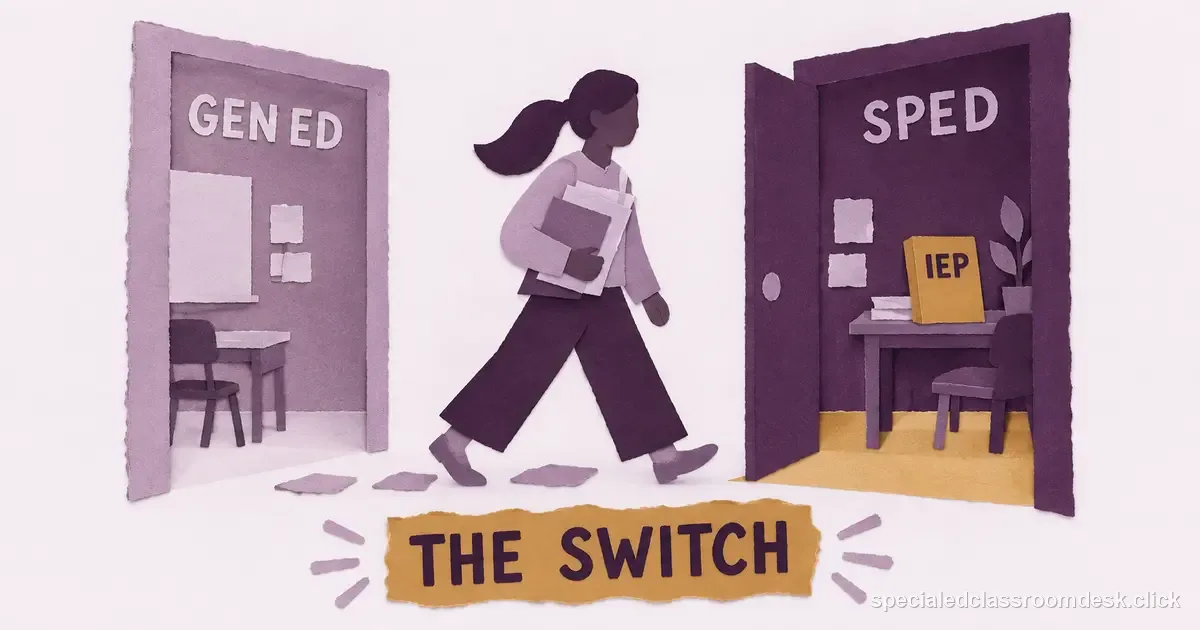
A general education teacher moving into special education already knows classrooms, curriculum, families, grading, and the pace of a school year. The surprise is usually not “how to teach.” It is the layer of individualized service delivery and case management that sits beside instruction: IEP writing, progress monitoring, service schedules, evaluation participation, accommodations, meetings, and coordination across multiple adults.
Choose the special education role before choosing the endorsement route
Do not start with the question “How do I add special ed?” Start with the assignment you want. Co-teaching in middle school, elementary resource, self-contained functional academics, early childhood special education, transition services, and itinerant support can require different state authorizations and produce very different daily work.
Open several job postings and note grade band, disability area, subject expectations, case-management duties, and any additional endorsement named. Then take that list to the state licensing agency's current requirements.
Confirm what your existing license already satisfies
An experienced general education teacher may already meet the base-license or pedagogy requirements that a first-time candidate must complete, but the receiving special education endorsement can still require approved coursework, testing, supervised experience, or another state-specific route. Requirements vary by state.
Use the state agency to determine whether you qualify for an add-on endorsement, must complete an approved special education program, or can teach while completing requirements under a recognized pathway.

Do not accept a special education assignment before you know the legal authorization
IDEA requires states to maintain personnel qualifications for special education teachers. Your district may be eager to fill a vacancy, but shortage pressure does not make licensure questions disappear. Ask what credential or state authorization will cover you on the first day and what conditions remain for full certification.
Learn IEP implementation before trying to master IEP prose
New special educators often worry about writing beautiful IEPs. The more urgent skill is understanding how the document drives the week. For each student, you need to know present levels, annual goals, services, frequency and setting, accommodations, behavior supports where applicable, progress-report expectations, and upcoming dates.
Take one sample IEP from your district's training materials and turn it into a service map. Where would the specially designed instruction occur? Who collects goal data? Which accommodations affect general education classes? That exercise makes the IEP operational rather than abstract.
| General education experience | Special education assignment | |
|---|---|---|
| Work that carries over | Curriculum, classroom routines, families, grading | Classroom knowledge and grade-level demands |
| Additional layer | IEP service delivery and individualized instruction | Goals, data, meetings, schedules, and coordination |
| Preparation question | Current license may meet some base requirements | State authorization and local workflow still need planning |
Practice goal writing with baseline data
A measurable annual goal should connect current performance to an observable target and a workable measurement method. Avoid memorizing a single sentence formula. Instead, practice with actual classroom skills: reading fluency measured with comparable passages, computation measured with brief probes, written expression scored with defined rubric elements, or self-regulation measured through observable strategy use.
As a former general educator, you can bring strong knowledge of grade-level demands. The special education task is to connect that curriculum context to individualized baseline and progress data.
Case management changes how you use planning time
Your prep period may now include meeting scheduling, parent communication, data review, collaboration with related-service providers, and drafting IEP sections in addition to lesson planning. Ask the prospective school how case managers receive meeting coverage and how annual-review clusters are distributed across the year.
If the answer is “everyone just does paperwork after school,” treat that as workload information, not as a rite of passage.
Learn the difference between accommodation and modification early
General education experience helps here because you know what the core task is supposed to measure. An accommodation changes access or how the student participates without necessarily changing the learning expectation; a modification changes what the student is expected to learn or demonstrate. State assessment rules and local grading practices can add complexity, so use the student's IEP and district guidance rather than informal labels.
Ask how progress monitoring actually works in that building
Who provides probes or rubrics? Where is data entered? How often do teachers receive protected time to review trends? What happens when a student is not making expected progress? A strong school should be able to describe the system beyond “collect data.”
Interview the support structure, not only the principal
If possible, talk with a current special educator or department lead. Ask about typical caseload, number of preps, paraeducator staffing, behavior support, related-service coordination, IEP meeting coverage, new-teacher mentoring, and how often special educators are pulled to substitute or cover other duties.
Your years in general education make you experienced, but they do not eliminate the need for role-specific induction.
Use the first semester to build repeatable systems
Create one calendar for IEP and reevaluation dates, one secure location for progress-monitoring records, a weekly block for case-management follow-up, and a predictable routine for communicating accommodations to general educators. Keep these systems simple enough to maintain during report-card and meeting-heavy weeks.
Evaluate the move by role fit, not by the hardest month
The first IEP cycle can feel disproportionately difficult because every process is new. At the end of the semester, assess what is improving with experience and what remains structurally unsustainable. If documentation takes less time but the service schedule is still impossible, the problem is staffing or assignment design rather than beginner inefficiency.
A midcareer switch can be a strong fit for teachers who want more individualized instruction and collaborative problem-solving. The safest transition combines the correct state authorization with a realistic picture of case-management work before the contract is signed.
Grade band, program type, case-management duties, and state authorization can vary by role. Use the target assignment to identify the route and mentoring needs.
Use a 30-day role-fit check before the semester gets busy
Meet with an experienced special educator or administrator to review the district’s IEP platform, meeting calendar, service-delivery expectations, evaluation workflow, and escalation path for missed deadlines. Shadow a case conference and a service block if permitted, using the district’s privacy rules. At the end of the first month, list what is working, what remains unclear, and which tasks require additional training or protected time. Separate duties that are new because of special education from problems caused by a particular school schedule or assignment. Ask the supervisor to identify one skill-building priority and one workload safeguard for the next month. This regular check-in helps a midcareer teacher build competence without assuming that every difficulty is a personal failure or that every system issue can be solved by working longer.
Sources checked
Questions teachers ask
Can an experienced general education teacher move directly into special education?
Sometimes, but the required endorsement or preparation route varies by state. Confirm the authorization needed for the specific special education assignment.
What is the biggest work change after moving to special education?
For many teachers it is the addition of individualized service delivery and case management—IEPs, progress monitoring, meetings, timelines, and coordination—alongside instruction.
Should I choose the endorsement before choosing a special education role?
Usually choose the target role first so you know which grade band or specialty authorization the state and employer require.
Does general education experience reduce the need for special education mentoring?
It reduces the classroom-learning curve but not the need to learn IEP implementation, case management, special education data systems, and local compliance workflows.